Stop Wasting Developer Time: A Practical Technical SEO Priority Framework for 2026
Technical SEO isn’t a checklist—it’s an investment decision. Here’s a practical framework to prioritize what actually moves revenue, protect dev cycles, and prepare your site for AI-driven search without getting trapped in audit-score busywork.

Technical SEO has a branding problem. Too often it’s treated like a never-ending checklist where the “win” is turning every audit warning green. That mindset is expensive, slow, and—most importantly—frequently disconnected from outcomes a business actually cares about: leads, revenue, retention, and operational efficiency.
In 2026, the pressure is even higher. Teams are juggling traditional Google search, AI-driven discovery, and shrinking attention spans—while developer time remains the scarcest resource in the building. The right question is no longer, “Is this a best practice?” It’s: “Is this the best use of our next two weeks of engineering effort?”
This editorial is inspired by Search Engine Land’s analysis of technical SEO busywork and how to avoid it, but it is intentionally written as a standalone playbook you can use inside an SME, an ecommerce brand, or an agency. Source: Search Engine Land – The biggest technical SEO time-wasters to avoid.
Concise summary

- Stop treating technical SEO like a checklist. Treat it like a backlog competing for sprint capacity.
- Most “time-wasters” aren’t inherently bad—they’re just mis-prioritized when your site doesn’t have the problem they solve.
- Use a 5-question triage to decide what to fix now, what to schedule, and what to ignore.
- Prioritize technical work that impacts revenue, unlocks other growth work, or improves AI-search readiness.
- Execution is where SEO strategies die. Systems that monitor, propose changes, get approval, and execute reliably (like AYSA) create compounding gains.
Table of contents
- The new reality: technical SEO is a queue, not a checklist
- Why “time-wasters” keep winning: incentives, tools, and fear
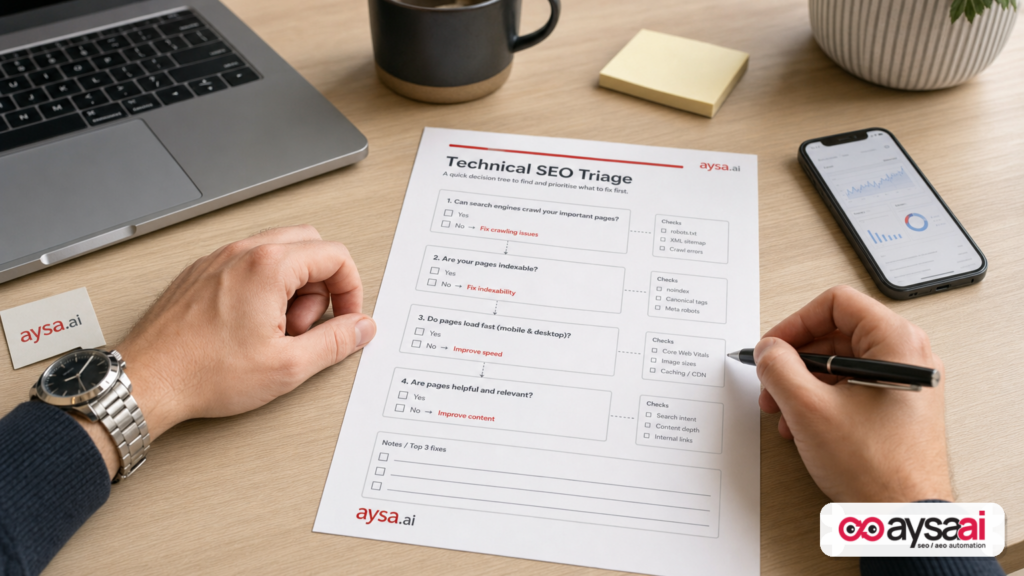
- A decision framework: the 5-question technical SEO triage
- The usual technical SEO time-wasters (and when they actually matter)
- What to do instead: technical SEO that actually compounds
- A concrete SME scenario: the ecommerce brand bleeding revenue from “minor” technical issues
- Technical SEO for AI search: what changes and what stays the same
- What agencies should rethink (and how to sell technical SEO honestly)
- Monitoring beats heroics: how to prevent regressions
- Where AYSA fits: approved execution, not more reports
- What to do next: a 30-day action plan
- Sources and further reading
The new reality: technical SEO is a queue, not a checklist

Most businesses have a finite amount of engineering time. Even when you “have dev resources,” you don’t really have dev resources—you have a line. Product has a line. Security has a line. Analytics has a line. Performance has a line. And SEO? SEO is just another stakeholder asking to cut the line.
That’s why modern technical SEO needs to be framed like an investment portfolio:
- Some work is foundational: indexation, Canonicalization, crawl paths, rendering, and content accessibility.
- Some work is incremental: performance improvements, template refinements, Internal linking enhancements.
- Some work is cosmetic: clearing warnings that do not correlate to user outcomes or search outcomes.
The danger isn’t that cosmetic tasks exist. The danger is they can consume weeks of effort because they are easy to specify, easy to measure (in the tool), and easy to claim as progress—while revenue-driving issues quietly sit unresolved.
This is the heart of the argument made in Search Engine Land’s piece: don’t invest developer time unless you understand the expected impact and how you’ll measure success (source).
Why “time-wasters” keep winning: incentives, tools, and fear
If you’ve ever wondered why technical SEO teams keep returning to low-impact tasks, it’s not because people are lazy. It’s because the system rewards the wrong outputs.
1) Audit tools create a false scoreboard
Most SEO crawlers and audits are useful, but they are not strategic. They flag patterns and deviations, not business priorities. A warning light is not a business case.
When the tool becomes the scoreboard, teams optimize for the scoreboard. That’s how you end up with sprint after sprint of “fix warnings” while conversion funnels break and Indexing drifts.
2) Easy tasks feel safer than hard tasks
Fixing a redirect here, a 404 there, removing a deprecated tag—these tasks feel clean and controllable. But the highest ROI technical work is often messy and cross-functional: template changes, navigation restructuring, rendering issues, or product feed consistency.
3) “Best practice” is used as a substitute for judgment
Best practices are starting points, not mandates. A best practice without context becomes superstition. The source article calls out this pattern directly: if you’re doing it only to “check a box,” stop and re-evaluate (source).
4) Dev time is expensive—so the cost of a wrong request is enormous
Every SEO request has an opportunity cost. If your fix uses 20 engineering hours, that might mean:
- a checkout optimization didn’t ship,
- an onboarding flow improvement got delayed,
- a tracking fix didn’t happen,
- a security patch got bumped.
Technical SEO maturity is not “how many issues you found.” It’s “how often you were right about what mattered.”
A decision framework: the 5-question technical SEO triage
Here’s the framework I recommend to SMEs, in-house teams, and agencies. It’s intentionally simple. If you can’t answer these questions, you probably aren’t ready to ask for developer time.
Question 1: What is the user-visible problem?
Describe the issue without using SEO vocabulary. Examples:
- “The page takes too long to load on mobile and users abandon.”
- “Customers land on out-of-stock products from Google and bounce.”
- “Google isn’t finding our new service pages.”
If the only description is “the tool flagged it,” it’s not a problem yet—it’s a hypothesis.
Question 2: What is the search-visible symptom?
Now map the user problem to search symptoms you can observe:
- Declining Impressions/Clicks for key pages (Search Console).
- Pages excluded from indexing or canonicalized incorrectly (Search Console).
- Important pages crawled infrequently or discovered late (Search Console).
Google Search Console is not perfect, but it is primary evidence from Google. If you’re not using it, you’re flying blind. Start here: Google Search Console help (official).
Question 3: What business metric moves if we fix it?
Pick a metric the business already cares about:
- Revenue, qualified leads, booked calls
- Conversion rate, add-to-cart rate
- Cost per acquisition (if SEO reduces paid dependency)
- Support tickets (if technical issues cause user confusion)
Search Engine Land emphasizes tying technical work to business goals and ROI, not just “SEO best practice” (source).
Question 4: What’s the smallest safe change that proves impact?
Don’t ask for a platform rewrite. Ask for the smallest change that can be measured. Examples:
- Fix one template used by the top 50 revenue pages.
- Improve internal links for one category cluster.
- Reduce load issues on the highest-traffic landing pages.
This is how you avoid boiling the ocean—and how you earn the right to do bigger work later.
Question 5: How will we measure success and avoid regressions?
Define:
- Leading indicators: crawling/indexing status, render parity, template output consistency.
- Lagging indicators: rankings are noisy; prefer impressions/clicks, conversions, revenue where possible.
- Guardrails: monitoring so the same issue doesn’t return next release.
If you can’t define measurement, you may still do the work—but you should label it clearly as “risk reduction” or “future-proofing,” not “guaranteed growth.”
The usual technical SEO time-wasters (and when they actually matter)
Technical SEO “time-wasters” are contextual. A task that’s pointless for a 200-page site can be critical for a 20-million-URL marketplace. The key is knowing when a task solves a real constraint.
Below are the most common traps called out in the Search Engine Land article, with added business framing and decision criteria (source).
Core Web Vitals perfectionism
The trap: continually optimizing Core Web Vitals even when you’re already in acceptable ranges.
When it matters:
- Your key landing pages are failing thresholds and users are actually struggling to load or interact.
- You can tie improvements to conversion friction (checkout, lead forms, appointment booking).
When it’s likely diminishing returns:
- You’re already “good” and you’re shaving milliseconds to satisfy a dashboard.
- Your biggest problem is content relevance, offer clarity, or poor internal linking.
What to do instead: Focus performance work where it intersects revenue pages and critical user flows. For official context on how Google thinks about page experience signals, see Google’s page experience documentation.
Redirect cleanup without a crawl problem
The trap: treating all redirects as “bad” and cleaning them up for aesthetic reasons.
When it matters:
- Redirect chains/loops are causing crawling waste or slow user journeys.
- Redirects lead to irrelevant destinations (soft 404 behavior).
- Internal links point to redirected URLs at scale (creating avoidable friction).
When it can wait:
- There are a handful of clean 301s that reflect real site evolution.
- You aren’t seeing crawl issues or indexing anomalies connected to redirects.
Primary guidance note: Google has historically recommended minimizing unnecessary redirect chains for performance and crawling efficiency, but the practical threshold depends on scale and architecture. If you need official detail beyond what’s provided here, consult Google’s Search documentation directly; if you can’t validate a specific threshold for your site, treat it as an engineering hygiene item—not a growth lever.
Crawl budget obsession on small sites
The trap: spending weeks “optimizing crawl budget” when Google is already crawling your important pages.
When it matters:
- Large sites with massive URL counts, faceted navigation problems, spider traps, parameter explosions.
- Search Console shows important pages discovered late, crawled rarely, or not indexed due to crawl constraints.
When it’s mostly noise:
- SME sites where the total indexable footprint is manageable.
- You don’t have uncontrolled URL generation or infinite spaces.
What to do instead: Fix the root causes of uncontrolled URL growth (filters, parameters, internal linking). Use Search Console crawl stats and index coverage signals as evidence (GSC official).
Fixing every 404 like it’s a fire
The trap: trying to eliminate every 404 because a tool reports them.
Reality: 404s are normal. Websites change. Content expires. Product SKUs end. The goal is not “no 404s.” The goal is “no harmful 404s.”
When it matters:
- High-traffic pages returning 404s.
- Broken internal links damaging UX and crawl paths.
- Backlinked pages returning 404s where a relevant alternative exists.
When it’s busywork:
- Low-value, never-visited URLs from old experiments or irrelevant external links.
What to do instead: Segment 404s by impact (traffic, backlinks, conversions). Fix the top slice. Monitor the rest.
Removing meta keywords and other museum pieces
The trap: allocating developer time to remove legacy tags (like meta keywords) because they’re obsolete.
When it matters: Almost never as a priority. It might matter during a template modernization project where you’re already changing head elements for bigger reasons (rendering, indexing directives, canonicals, structured data).
When it’s a waste: when it’s the only reason you’re touching templates.
Routine disavow maintenance
The trap: maintaining a disavow file on a schedule as if it’s standard site maintenance.
When it matters:
- If you have a clear reason: a manual action, documented toxic link campaigns, or a historic agency mess you must clean up.
When it’s likely wasted effort:
- “Just in case” disavowing without evidence of a penalty or actual risk.
Primary-source note: Google provides a disavow tool, but also warns it should be used with caution. If you’re considering disavow as routine hygiene, you likely don’t need it. If you need official instructions, consult Google’s own help content directly; don’t rely on tool vendors as a primary authority.
Chasing audit scores instead of outcomes
The trap: making “clear all issues” the goal.
Why it happens: scores are simple. They create the feeling of progress. They help justify retainers. They look good in a monthly report.
Why it fails: a technically “perfect” site that doesn’t answer customer intent still loses. A technically “messy” site with clear offers, strong internal linking, and high trust often wins.
What to do instead: Use audit tools as diagnostic support, not as your strategy. The source article explicitly warns against letting tools dictate your roadmap (source).
What to do instead: technical SEO that actually compounds
So if you’re not burning time on cosmetic fixes, where should technical SEO effort go?
Search Engine Land proposes three criteria for worthwhile work: impact on business goals, enabling other work, and preparing for AI-driven search (source). I agree—and I’d sharpen it into a compounding model.
1) Fix problems that block search from seeing your best pages
- Indexation/canonical issues that cause the wrong version to rank.
- Rendering problems that hide content/links from bots.
- Internal linking gaps that orphan money pages.
If search engines can’t reliably access and understand your core pages, everything else is decoration.
2) Fix problems that block users from converting
- Slow or unstable templates on top landing pages.
- Broken mobile UX in lead forms or checkout.
- Misleading navigation that causes pogo-sticking.
This is where technical SEO stops being “SEO” and becomes revenue optimization.
3) Fix problems that amplify every future change
- Template-level improvements (not one-off page edits).
- Automation for consistent metadata, canonicals, hreflang (when relevant), and structured data.
- Monitoring and alerting so regressions don’t recur.
Compounding comes from repeatability.
4) Make technical changes that improve clarity for humans and machines
Search is converging with AI assistants and answer engines. Clear structure helps both:
- Clean information architecture
- Consistent entity naming
- Structured data where appropriate
- Fast, stable pages that load on real devices
If you want to orient around AI visibility over time, explore AYSA’s approach to tracking AI presence: AYSA AI Search Visibility.
A concrete SME scenario: the ecommerce brand bleeding revenue from “minor” technical issues
Let’s make this real with a scenario I see constantly.
Business: a 12-person ecommerce brand selling specialty home goods. They rely on organic search for category discovery and paid social for demand capture. They’re not a massive enterprise. They’re an SME with limited dev time (one part-time developer plus an agency).
What the SEO audit screams about:
- Dozens of 404s
- Some redirected URLs
- Meta keywords present on older templates
- Mixed “needs improvement” page-speed flags
What the business is actually experiencing:
- High-intent category pages are indexed, but they don’t hold rankings.
- Product pages fluctuate: some get discovered, many don’t.
- Mobile conversion is weak compared to desktop.
If you chase audit perfection, you spend a month cleaning up 404s and removing meta keywords. The business sees no material change.
If you use triage, you might discover instead:
- Internal linking is inconsistent after a theme update; categories no longer link to subcategories in a crawlable way.
- Critical content loads late due to a script dependency; users bounce before they see product grids.
- Duplicate category pages exist due to parameter handling, splitting relevance and confusing canonical signals.
The high-impact plan becomes:
- Fix category → subcategory linking so Google and users traverse your catalog.
- Stabilize mobile performance on category templates (where discovery starts).
- Consolidate duplicate category variants via canonical rules and internal linking rules.
Notice what’s missing: “eliminate every 404.” You still handle 404s, but you do it by impact—starting with those that break internal paths or receive meaningful traffic.
Technical SEO for AI search: what changes and what stays the same
There’s a lot of noise in the market about “AI SEO.” Here’s the grounded version: AI-driven search experiences still rely on web content that can be accessed, understood, and trusted. Technical SEO remains the foundation—but the evaluation lens is changing.
What stays the same
- Accessibility and crawlability: if bots can’t fetch or render it, you don’t exist.
- Clear site structure: AI systems benefit from coherent information architecture.
- Performance and UX: users still click through; slow pages still lose.
What changes
- Entity clarity becomes more important: consistent naming, structured representation, and strong “aboutness” signals can help systems interpret what you are.
- Verification and trust signals matter more: as AI systems summarize, misattribution and confusion increase. Businesses need consistent identifiers and factual consistency across the site.
The Search Engine Land ecosystem is increasingly covering schema/entity gaps and AI search verification challenges (see links like Schema for AI search: How to identify and prioritize entity gaps and AI search can’t verify your business — here’s how to fix it). You don’t need to chase every new tactic, but you do need to build a site that is unambiguous.
Practical AI-ready technical priorities for SMEs:
- Ensure your About/Contact/Policies pages are crawlable and consistent.
- Use structured data where it truly matches the page content (avoid spammy markup).
- Make important pages easy to discover through internal linking (not just menus rendered in complex scripts).
- Reduce duplicate/near-duplicate pages that create entity confusion.
If your team wants a system-level view of where you appear across AI-driven discovery, start with: AI Search Visibility.
What agencies should rethink (and how to sell technical SEO honestly)
Agencies are under pressure: retainers must be justified, deliverables must be visible, and technical SEO is easy to package as “we fixed 137 issues.” The problem is that clients don’t pay for issue counts. They pay for outcomes.
If you run an agency (or manage one), here’s what to rethink:
1) Stop selling “best practices.” Sell constraints.
Position technical SEO work as removing constraints that block performance:
- Constraint: “Google isn’t indexing our new landing pages.”
- Constraint: “Mobile UX is breaking lead capture.”
- Constraint: “Duplicate pages split relevance.”
Constraints are measurable. Best practices are arguable.
2) Build a shared priority rubric with your client
Define categories like:
- P0: Revenue/indexing blockers
- P1: Material efficiency improvements
- P2: Quality/maintenance
- P3: Cosmetic
Then force every audit item into a bucket. If you can’t defend the bucket, you don’t ship the request.
3) Separate “technical hygiene” from “growth” in reporting
Hygiene matters. But it should be reported as risk reduction, not growth. Growth items should be tied to metrics the business recognizes.
4) Don’t let tools dictate the roadmap
This is a direct reinforcement of the Search Engine Land point about “clearing audit tool issues” becoming a distraction (source).
Monitoring beats heroics: how to prevent regressions
One of the most expensive patterns in technical SEO is regression: you fix something, celebrate, and then a theme update or release quietly undoes your work.
Instead of relying on periodic audits and heroics, build monitoring that alerts you when business-critical signals drift:
- Indexation changes for key page groups
- Template changes that alter titles, canonicals, robots directives
- Sudden spikes in 404s on important URLs
- Performance degradations on top landing pages
This is where systems matter. Monitoring isn’t glamorous, but it’s how SEO becomes stable enough to compound. If you want to see how AYSA approaches this, start here: AYSA Monitoring.
Where AYSA fits: approved execution, not more reports
Most SEO stacks do one thing well: they tell you what’s wrong. The market is saturated with “insights.” What businesses lack is reliable execution—especially when execution requires coordination across marketing, engineering, and leadership.
AYSA is built around a simple but rare operating model:
- Monitor: track technical and visibility signals so problems are caught early.
- Prepare: generate specific, reviewable change proposals (not vague recommendations).
- Ask for approval: ensure humans stay in control—especially important for SMEs and regulated industries.
- Execute accepted changes: ship improvements consistently, without turning every fix into a multi-week coordination project.
This matters because the real enemy of technical SEO is not ignorance—it’s delay. A fix that ships in 7 days can prevent a quarter of lost revenue. A fix that sits in a backlog for 90 days is just a well-written document.
If you’re evaluating operational fit, start with:
What to do next: a 30-day action plan
This is the practical implementation plan you can use whether you’re a founder, a marketing lead, or an agency account manager.
Week 1: Define what “impact” means for your business
- Pick 1–2 business metrics: leads, revenue, bookings, trial starts.
- List your top 20 organic landing pages (by revenue or qualified leads, not just traffic).
- In Google Search Console, check indexing status and performance trends for those pages (GSC official).
Week 2: Run triage on your technical backlog
- Take your audit report and categorize every item into P0–P3.
- For each P0/P1 item, answer the 5 triage questions (user problem, search symptom, business metric, smallest test, measurement).
Week 3: Ship one measurable fix
- Choose a fix with clear measurement (template-level if possible).
- Document pre-change baseline: indexation, impressions/clicks, conversion behavior.
- Launch and QA. Verify in Search Console as appropriate.
Week 4: Install monitoring and prevent regressions
- Create alerts for key page groups and key templates.
- Define an “SEO QA checklist” for releases that affect navigation, templates, or head tags.
- Decide what gets auto-proposed vs. what always requires stakeholder approval.
What to do next (action list)
- Stop clearing warnings. Start building a backlog prioritized by business impact.
- Use Search Console as primary evidence for indexing and search symptoms (official).
- Pick one technical fix that affects your top landing-page template and measure it end-to-end.
- Build monitoring so fixes don’t regress after the next release (AYSA Monitoring).
- Track AI visibility as a parallel signal so you’re not surprised by how discovery shifts (AYSA AI Search Visibility).
Sources and further reading
- Search Engine Land – The biggest technical SEO time-wasters to avoid
- Google Search Console help (official)
- Google Search Central – Page experience documentation (official)
- Search Engine Land – Schema for AI search: How to identify and prioritize entity gaps
- Search Engine Land – AI search can’t verify your business — here’s how to fix it
- Search Engine Land – 7 reasons your SEO tests fail and how to fix them
- Search Engine Land – The hidden cost of a ‘wait and see’ SEO strategy
Note: Where official primary sources were not provided in the supplied research context, I avoided making claims that require external verification (for example, exact thresholds for redirect “hops” or disavow usage frequency). If you want a stricter, citation-heavy version of this guide for enterprise governance, we can expand the Sources section with additional official documentation during editorial review.
Continue the AI search topic inside AYSA.
Use these pages to connect the article with AI SEO tools, AI visibility monitoring, AI Overviews and approved website execution.
Turn this topic into a website action plan.
Use these AYSA hubs to move from reading to technical fixes, AI visibility monitoring, research, glossary context and approval-first SEO execution.