How to Win SEO Budget With a CFO (Without Talking About Rankings)
CFOs don’t buy “more traffic.” They buy lower risk, better unit economics, and predictable pipeline. Here’s a practical, CFO-ready way to model SEO as a defensible investment—especially as AI search changes how demand is created and captured.
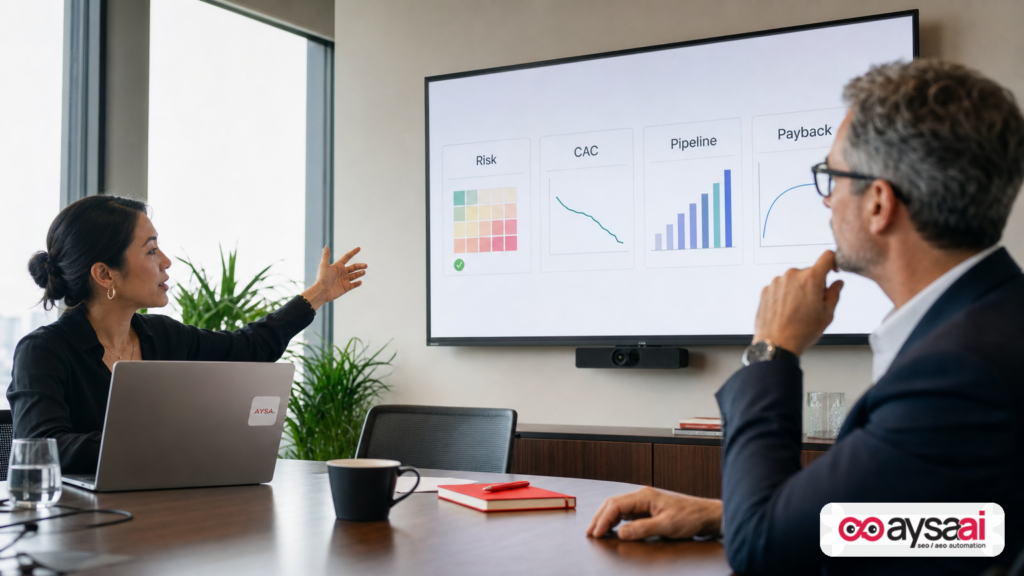
Most SEO budget conversations with a CFO fail for the same reason most SEO reports are written: they’re built for SEO people. Rankings, Clicks, and “Share of Voice” feel persuasive inside marketing, but they don’t map cleanly to a CFO’s job: allocate capital, reduce risk, and protect the P&L.
And in 2026, the stakes are higher. Search is becoming more AI-mediated, Attribution is more fragile, and customer acquisition costs (CAC) are harder to control. If you frame SEO as a channel, you’ll be debated like a channel. If you frame SEO as a risk-managed growth asset, you’ll be evaluated like an investment.
This editorial is my CFO-ready playbook for getting SEO funded (and kept funded) without asking finance to “believe in SEO.” It’s based on the thinking highlighted in Search Engine Land’s discussion of winning SEO budget conversations, combined with what we see every day building execution systems at AYSA.ai.
Concise summary

- CFOs don’t fund rankings. They fund risk reduction, unit economics (CAC/LTV), and pipeline reliability.
- Search has structurally changed: AI answer layers and zero-click behavior make “traffic up” a weaker proxy for growth.
- The winning SEO budget case is a model: what happens to CAC and pipeline if you under-invest, and what the payback looks like if you invest.
- Execution speed is the moat. If your SEO strategy is good but your changes take months, your ROI will be capped.
- AYSA fits as an Approved Execution system: monitor, prepare changes, request approval, and execute accepted updates—so SEO becomes operational, not aspirational.
Table of contents

- The real reason SEO budget conversations break down
- What changed: search is now an AI-mediated market
- What a CFO actually wants from marketing spend
- Stop leading with rankings (what to lead with instead)
- The CFO language: three risk frames that work
- The CFO-ready model: SEO as a risk-adjusted growth asset
- The three questions you will be asked (and how to answer them)
- A concrete SME scenario: eCommerce brand facing CAC creep
- What agencies must change: from “deliverables” to unit economics
- Turn SEO into an operating system: governance, cadence, accountability
- Where AYSA fits: approved execution, not more meetings
- What to do next: a CFO-ready action plan
- Sources and further reading
The real reason SEO budget conversations break down
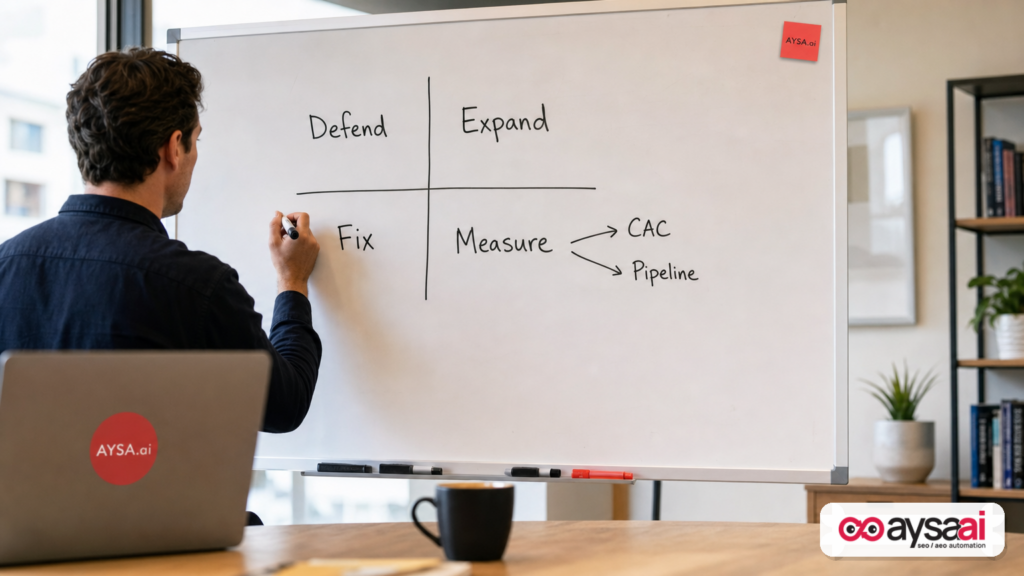
Marketing leaders often walk into finance reviews trying to “prove” SEO with outputs: more pages published, more keywords ranking, more sessions, more Impressions. The intent is good: show progress, justify effort.
The outcome is predictable: the CFO hears “activity,” not “returns.” And if they’ve seen CAC rising across the business—despite more spend—they’re already skeptical.
Here’s the uncomfortable truth: channel metrics are not inherently financial metrics. You can have record Organic traffic and still lose money. You can lose some traffic and increase profit. A CFO’s job is to ask: which one is happening here?
So the conversation breaks down at the first translation step. SEO says “visibility.” Finance says “cash.” If you can’t bridge that gap, the budget will be treated as discretionary.
This isn’t because CFOs “don’t get marketing.” It’s because they’ve been trained—through painful experience—not to trust attribution stories that can’t be stress-tested.
What changed: search is now an AI-mediated market
For years, search economics were simpler:
- Users searched.
- Google showed blue links plus ads.
- Traffic flowed to publishers and businesses.
- Marketers measured visits and conversions.
That mental model is outdated. AI answer layers (including Google’s evolving experiences and the broader shift toward LLM-style discovery) are changing how demand is captured:
- More queries end without a click because the answer is synthesized on the results page or inside an assistant-like interface.
- Brand visibility is becoming citation visibility: it matters whether you’re referenced, recommended, or summarized—sometimes even if the user never lands on your site.
- Competition is multi-surface: you’re not only competing with “the other ten blue links,” but also with aggregators, marketplaces, and platforms that win the answer layer.
Search Engine Land’s piece on CFO conversations correctly pushes teams to stop selling “rankings” and start selling commercial outcomes and risk management (source). I’ll go one step further: in an AI-mediated environment, the old SEO reporting story is not merely ineffective—it can be misleading.
When the discovery layer changes, your KPI stack must change, and your budget justification must change with it.
AYSA’s perspective: this is why we focus on AI search visibility and operational Monitoring rather than one-time audits. The market moves weekly; your execution model has to keep up.
What a CFO actually wants from marketing spend
Most CFOs are not anti-growth. They’re anti-uncertainty. Their best questions typically fall into a few categories:
1) Predictability
Can we forecast outcomes within a reasonable range? Can we explain variance when it happens?
2) Unit economics
What does it cost to acquire a customer (CAC)? How does that compare to gross margin and LTV? What’s the payback period?
3) Opportunity cost
If we spend here, what aren’t we spending on? Why is this allocation the best use of capital now?
4) Downside protection
What are the risks if we under-invest? How fast do those risks materialize? What’s the cost to recover?
Notice what’s missing: the CFO rarely starts with “How many keywords are we ranking for?” Not because it’s irrelevant, but because it’s a derivative metric. It’s a means, not an end.
Stop leading with rankings (what to lead with instead)
If you want a budget “yes,” the first five minutes matter. Your opener must establish shared reality in business terms.
What not to do
- “We grew organic traffic 18% YoY.”
- “We improved average position from 14 to 9.”
- “We published 62 pieces of content.”
Those statements invite the CFO’s silent counterfactual: Would we have gotten the revenue anyway? If you can’t answer that, every slide after is fragile.
What to do instead: open with the structural diagnosis
Open with a short, finance-compatible statement:
- What changed in the acquisition environment (AI layers, CPC inflation, competitor displacement).
- What it’s doing to your unit economics (blended CAC, payback, pipeline consistency).
- What you’re doing to manage the risk and improve the slope over time.
This is aligned with the core recommendation in the Search Engine Land article: CFOs approve investments that reduce risk and justify allocation—not decks full of channel performance (source).
The CFO language: three risk frames that work
If you remember one thing, remember this: SEO is easiest to fund when it’s framed as risk management with upside. Upside-only pitches are optional. Risk-based pitches feel necessary.
Here are three risk frames that consistently land with finance, without relying on questionable attribution.
1) Competitive displacement risk (the “compounding loss” problem)
Organic visibility is contested. When you reduce investment, competitors don’t “pause.” They keep publishing, keep improving pages, keep earning mentions, and keep expanding into your topics.
The business risk is not “we’ll lose rankings.” The risk is:
- Share of demand shifts to competitors.
- Paid spend must compensate to maintain pipeline.
- Recovery costs exceed maintenance costs because you’re rebuilding authority and coverage from behind.
A CFO can model this as an expected cost over time: “If organic contribution drops X%, what does that force paid to do at current CPCs and conversion rates?” Even if the assumptions are debated, the structure is sound.
2) AI visibility risk (the “new discovery layer” problem)
In AI-mediated search, being the best answer is not the same as being the top link. Brands increasingly win when they have:
- Content depth and coverage (not thin pages)
- Clear entities and structure (so systems can parse and summarize)
- Demonstrable authority and trust signals
The CFO-friendly argument: AI visibility is built, not bought. If you lose it, you can’t instantly purchase your way back the way you might with paid media next quarter.
Search Engine Land’s broader coverage has been tracking AI’s growing role in search and marketing surfaces (for example, the site’s ongoing reporting on AI-related shifts in discovery and traffic patterns, such as AI referral discussions: Search Engine Land). You don’t need to overclaim “AI will kill traffic” to make the financial point: the discovery layer is changing, so defensive investment becomes rational.
3) CAC blowout risk (the “you’ll pay more later” problem)
When organic weakens, businesses often compensate with paid. That pushes blended CAC up. If finance later forces paid cuts before organic is strong enough, pipeline falls and CAC rises again as efficiency deteriorates.
Think of it as a three-step trap:
- Paid becomes more expensive (competition + auctions + saturation).
- Organic fails to offset because coverage/authority lags.
- Growth slows, so budgets tighten—making the organic gap even harder to close.
The SEO budget pitch that works here is not “SEO is cheaper than ads.” That’s too simplistic. The pitch is: SEO reduces paid dependency and volatility. CFOs like volatility reduction because it improves forecasting and reduces risk.
The CFO-ready model: SEO as a risk-adjusted growth asset
If I were walking into your CFO meeting with you, I’d want you to show a single page first—before any keyword data. That page is your model.
Here’s the structure.
Step 1: Define the business outcomes SEO influences
Pick outcomes that are already in your revenue process. Examples:
- Qualified leads (not raw leads)
- Demo requests
- Ecommerce transactions
- Calls / bookings (for local services)
- Pipeline value (if you have it) and close rate
You do not need to claim perfect attribution. You need to show credible directional influence with data the CFO already trusts.
Step 2: Connect organic contribution to unit economics (without pretending it’s exact)
Instead of “SEO ROI,” use these finance-friendly bridges:
- Incremental cost avoidance: what paid would have to spend to replace a portion of organic-driven outcomes.
- Blended CAC sensitivity: how changes in organic share correlate with changes in paid efficiency and overall CAC.
- Payback period influence: how organic contribution shifts payback (especially for subscription businesses).
CFOs accept ranges and scenarios. They reject fragile precision.
Step 3: Build a scenario table (base / downside / upside)
Give finance something they can pressure-test. For example:
- Base: maintain investment; protect current visibility; improve conversion rates on existing pages.
- Downside: 20–30% cut; model compounding impact over 2–4 quarters; show recovery cost assumptions.
- Upside: targeted investment; prioritize revenue-close topics; improve conversion on high-intent pages.
This aligns with the “risk framing” emphasized in the Search Engine Land article: finance responds to downside scenarios they can quantify (source).
Step 4: Show what’s actually being funded (capabilities, not output)
SEO budgets get cut when they look like “content volume.” Reframe spend into capabilities:
- Technical capability: speed, indexation, structured data, crawl hygiene.
- Content capability: expert coverage, updating, pruning, alignment with buyer questions.
- Authority capability: digital PR, partnerships, citations/mentions where legitimate.
- Conversion capability: CRO on organic landing pages, lead quality improvements.
- Measurement capability: monitoring, QA, governance, and reporting tied to pipeline.
Capabilities are durable. Outputs are disputable.
Step 5: Commit to an execution cadence
This is where most teams lose the plot. They ask for money to “do SEO,” but they can’t explain how quickly the organization can ship the changes.
A CFO’s legitimate question: If I give you budget, how do I know anything will actually change on the website this quarter?
Execution cadence is a finance lever. It affects time-to-impact. And time-to-impact affects the internal discount rate the CFO applies mentally to your plan.
That’s why we built AYSA as an approved execution system—so teams can stop treating implementation like a separate project that “depends on dev time.” More on that below.
The three questions you will be asked (and how to answer them)
You can have a perfect narrative and still lose if you fumble these. Prepare crisp answers, plus a back-up appendix if someone wants detail.
1) “What happens if we cut this by 30%?”
Finance asks this because they need options. The wrong response is emotional: “That would be catastrophic.” The right response is modeled:
- Define what “30% cut” means operationally (fewer updates, fewer technical fixes, slower execution, less content refresh, fewer authority initiatives).
- Model expected impact over time (not next week). SEO impacts often show with lag.
- Offer an alternative: “If we must cut 30%, here’s the least damaging way—protecting the pages that support pipeline and the technical foundation.”
The key is to demonstrate that you understand efficiency curves and sequencing. Some cuts hurt far more than their percentage because they break compounding processes (maintenance, updates, technical health).
2) “How do we know this is incremental?”
This is the counterfactual question Search Engine Land highlights: would the revenue have happened anyway? You don’t need perfect proof, but you need credible evidence.
Answer with a portfolio of signals, not a single attribution claim:
- Demand capture evidence: changes in organic visibility for high-intent topics and how those correlate with qualified leads/sales over time.
- Market evidence: competitor displacement (where they now show up and you don’t) and what that means for paid compensation.
- Experiment evidence: controlled changes where you improved a set of pages (content + conversion) and tracked lead quality lift versus unchanged pages.
If your organization can’t run clean tests, say so—and propose a plan to build testing into the next quarter.
3) “Why can’t we just put this money into paid?”
This is common and reasonable. Paid is immediate and measurable. Your response should respect that reality.
Use a simple framing:
- Paid is a variable cost. When you stop paying, outcomes stop quickly.
- SEO is a compounding asset. The benefits can persist and improve over time, but only if you maintain quality and adapt to search changes.
- The goal is portfolio efficiency. A healthy business balances immediate demand capture (paid) with durable demand capture (organic/brand/authority).
In other words: you’re not anti-paid. You’re anti-fragile growth.
If you want to go deeper on paid pacing dynamics, Search Engine Land also published analysis about why frontloading ad spend can backfire (Search Engine Land). It’s a useful adjacent read because it reinforces the CFO’s lens: spend timing and marginal returns matter.
A concrete SME scenario: eCommerce brand facing CAC creep
Let’s make this real with a scenario that’s painfully common.
Business: a $4–8M/year ecommerce brand selling specialty home goods.
Current mix: mostly Google Ads + Meta retargeting, with some organic search traffic that “helps” but isn’t managed strategically.
Problem: year-over-year CAC is rising. The founder asks marketing to “do more SEO,” but the CFO (or finance-minded operator) sees SEO as slow and uncertain.
What the losing pitch sounds like
- “We’ll publish 40 blog posts.”
- “We’ll target these 200 keywords.”
- “We’ll grow traffic.”
The CFO hears: unclear payback, unclear linkage to orders, and no defensible downside case.
What the winning pitch looks like
You build a one-page model around two product categories that already sell well (high margin, high LTV through repeat purchases). Then you propose:
- Defend and expand commercial pages: category pages, product guides, comparison pages, FAQs that answer buying objections.
- Reduce paid dependency on branded and “easy win” terms where organic can carry more weight over time.
- Improve conversion on organic landings (better product education, shipping clarity, returns, trust signals).
- Ship improvements weekly, not quarterly.
Then you quantify risk:
- If paid auctions become 15–25% more expensive during peak season, what happens to margin if organic doesn’t increase its share of high-intent demand?
- If competitors build better buying guides and win answer/citation visibility, how much incremental paid spend is required to maintain volume?
You don’t need to invent numbers. You use your own store’s metrics: conversion rate, gross margin, AOV, repeat purchase rate, and current paid CAC. The point is to turn SEO from “content” into “financial resilience.”
If you want tooling support for this style of work, AYSA’s monitoring and visibility tooling are built for ongoing operational clarity (see AYSA Monitoring and AI Search Visibility).
What agencies must change: from “deliverables” to unit economics
If you’re an agency, the CFO problem is also a positioning problem.
Many agencies still sell:
- Monthly content quotas
- Link counts
- Audits and roadmaps
- Rank tracking
Those are deliverables, not outcomes. They’re also the easiest things for finance to cut because they look discretionary.
To survive (and grow) in AI-mediated search, agencies need to sell:
- CAC stabilization programs (reduce paid dependency over time)
- Pipeline resilience programs (protect demand capture from platform shifts)
- Execution velocity (ship changes weekly with QA and governance)
- Measurement that ties to the revenue process (not just Search Console screenshots)
Search Console still matters, but it’s an input. If you want to use it intelligently, you can combine it with an action-oriented workflow (Search Engine Land also published tactical guidance on turning Search Console data into action: Search Engine Land).
Agencies that win will behave less like “SEO vendors” and more like growth operations partners.
Turn SEO into an operating system: governance, cadence, accountability
A CFO is often right to question SEO because many SEO programs fail for non-strategy reasons:
- Changes sit in Jira for months.
- Content is published without conversion thinking.
- Technical fixes are deprioritized by product teams.
- No one owns updates after launch.
- Measurement is isolated inside marketing.
So before you ask for more budget, you need to show that SEO is run like an operating system with controls.
Governance: who can approve what?
Define approval paths for:
- Title/meta and on-page edits
- Internal linking changes
- Schema / structured data updates
- Content refreshes vs new pages
- Redirects and pruning decisions
Cadence: how often do you ship?
Set a weekly or biweekly release cadence for SEO improvements. Quarterly “SEO projects” are too slow in a market where competitors ship constantly.
Accountability: what’s the scoreboard?
Use a scoreboard with three layers:
- Leading indicators: coverage of high-intent topics, technical health, page quality updates shipped.
- Market indicators: visibility across important queries and AI discovery surfaces (where measurable), competitor displacement signals.
- Business indicators: qualified leads/orders, conversion rate from organic landings, blended CAC movement.
AYSA was designed for this operational posture. We’re not another “ideas tool.” We focus on monitored insights that become changes, queued for approval, then executed (learn more at AYSA AI SEO Tools and Monitoring).
Where AYSA fits: approved execution, not more meetings
Most businesses don’t have an SEO strategy problem. They have an execution bottleneck.
Even when leadership agrees SEO matters, implementation dies in a familiar place:
- “We need dev resources.”
- “We need legal review.”
- “We’ll do it next sprint.”
- “We published it, but no one updated it.”
That’s why “approved execution” is the center of AYSA’s model:
- Monitors your site and search visibility over time (not just one-off audits).
- Prepares specific recommendations and proposed website changes.
- Asks for approval so teams maintain governance and brand control.
- Executes accepted changes reliably—so plans become shipped improvements.
For CFO conversations, this matters because it answers a critical finance concern: Will this investment actually turn into implementable change this quarter?
If you want to evaluate fit, start with the product pages here: Pricing, plus the editorial library at AYSA Blog.
What to do next: a CFO-ready action plan
If you’re preparing for a CFO budget conversation in the next 2–6 weeks, do this in order.
1) Build your one-page model first
- Choose 1–3 outcomes (qualified leads, orders, pipeline) that finance already tracks.
- Create base/downside/upside scenarios with transparent assumptions.
- Add a “recovery cost” line item for the downside scenario.
2) Reframe SEO work into capabilities
- Technical foundation
- Commercial content coverage + refresh
- Authority building (legit PR/mentions, not spam)
- Conversion improvements on organic landings
- Measurement & governance
3) Bring a risk register, not a keyword list
List the top 5–10 risks that SEO investment mitigates (competitive displacement, AI visibility erosion, paid dependency volatility), and for each: time-to-impact, confidence level, and mitigation plan.
4) Commit to an execution cadence
Show how many meaningful changes you’ll ship per month, and who approves them. If execution is slow today, name the constraint and propose how to remove it (tools, process, owners).
5) Agree on a CFO-friendly KPI set
Keep it tight. A practical set might include:
- Qualified organic leads/orders (by intent segment)
- Conversion rate on top organic landing pages
- Blended CAC trend (and sensitivity to organic share)
- Pipeline influenced by organic entry points (with definitions)
- Execution velocity (changes shipped, time-to-ship)
Then keep the SEO metrics (rankings, impressions) as diagnostics in an appendix—not the headline.
6) Use AYSA (or an equivalent system) to remove implementation friction
If you want SEO to behave like an investment, you need repeatable execution. Explore:
- Monitoring to keep visibility and site issues from drifting unnoticed
- AI search visibility to adapt to AI-mediated discovery
- AI SEO tools that drive implementable change, not just analysis
What to do next (checklist)
- Draft a one-page SEO investment memo: outcomes, scenarios, assumptions, risks, cadence.
- Replace your first 10 slides with one chart: blended CAC vs organic contribution trend (even directional).
- Identify the top 20 “money pages” and create a refresh + conversion plan for each.
- Set an internal SLA: every approved SEO change ships within 10 business days.
- Decide how you’ll measure AI discovery visibility for your category (and note what’s not measurable yet).
- Pick an execution system (AYSA or your internal process) and operationalize weekly shipping.
Sources and further reading
- Search Engine Land: How to win SEO budget conversations with your CFO
- Search Engine Land: ChatGPT commands 92% of AI referral traffic (session analysis) (useful context on AI-driven referral behavior; validate applicability to your own analytics)
- Search Engine Land: Why frontloading your ad spend usually backfires
- Search Engine Land: 7 ways AI can turn Google Search Console data into action
- AYSA: AI Search Visibility
- AYSA: Monitoring
- AYSA: AI SEO Tools
- AYSA: Pricing
- AYSA: Blog
Note on sources: This editorial uses Search Engine Land as the primary research input and cites it directly. Where broader AI search or measurement claims are debated industry-wide, I’ve framed them as analysis rather than absolute fact unless a specific source is provided in the supplied research context.
Continue the AI search topic inside AYSA.
Use these pages to connect the article with AI SEO tools, AI visibility monitoring, AI Overviews and approved website execution.
Turn this topic into a website action plan.
Use these AYSA hubs to move from reading to technical fixes, AI visibility monitoring, research, glossary context and approval-first SEO execution.