YouTube In-App Sharing & Messaging Is Back: What It Means for SEO, Social Distribution, and the New “Dark Engagement” Era
YouTube’s revived in-app sharing and messaging pulls private video conversations back inside the platform. Here’s what changed, why it matters for SMEs and agencies, what to monitor, and how AYSA helps you execute the SEO/AEO/GEO work that turns attention into revenue.

YouTube is bringing in-app sharing and messaging to more eligible adults in more markets, including the U.S. That sounds like a product tweak. It’s not.
It’s a distribution shift that matters to anyone who relies on YouTube for reach and relies on Google (or AI answers) for conversions. When the “send this video to a friend” moment happens inside YouTube instead of WhatsApp, iMessage, or Slack, the platform regains visibility and control over a chunk of engagement that has been happening off-platform for years.
And when platforms regain control over engagement, two things usually follow: (1) they learn faster which content drives retention and sharing, and (2) marketers lose some Attribution clarity while the algorithm gets smarter.
This editorial unpacks what changed, why it matters for SMEs and agencies, what to monitor without guessing, and what to do next—especially if you want to translate social attention into search demand you can actually capture.
Primary source: Search Engine Journal’s coverage of the rollout: YouTube brings in-app sharing & messaging to the U.S.
Concise Summary
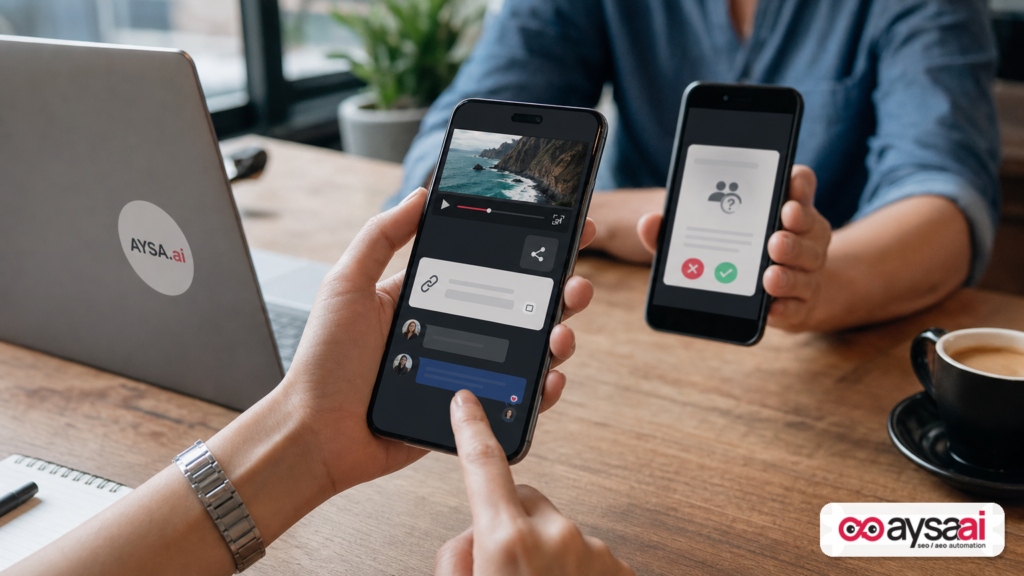
- YouTube is expanding an invite-based in-app messaging and sharing feature to additional markets, including the U.S., for eligible adults.
- This revives a version of YouTube messaging that was removed in 2019, after first launching in 2017 and then returning as a more limited experiment in late 2025.
- In-app sharing pulls some “dark engagement” (private sharing + private discussion) back onto YouTube—which can change distribution dynamics even if public metrics look unchanged.
- YouTube has not confirmed whether shares sent via in-app messaging appear differently in analytics or influence recommendations; treat that as unknown and measure outcomes instead.
- Businesses should prepare for attribution ambiguity by improving demand capture: brand and product pages, Internal linking, structured content, and Monitoring around video launches.
Key Takeaways (Read This If You’re Busy)

- This is about retention and recommendation loops: when sharing and conversation happen inside the app, YouTube can more easily learn what drives “keep watching” behavior.
- Private sharing is real buying behavior: people send videos when they’re comparing, validating, or recommending—high intent moments.
- Don’t wait for perfect analytics: build a measurement plan that connects YouTube publishing to Branded Search, assisted conversions, and on-site engagement.
- Use YouTube to create demand; use your website to convert it: if your site isn’t ready, the spike becomes someone else’s revenue (marketplaces, directories, competitors).
- Execution speed is the differentiator: the brands that win are the ones that update pages, structure content, and ship improvements fast—without endless internal back-and-forth.
Table of Contents
- What Changed: YouTube Is Pulling Sharing Conversations Back Into the App
- How the Feature Works (What We Actually Know)
- Why Messaging Matters Again: 2017 → 2019 Removal → 2025/2026 Return
- The Real Business Impact: “Dark Engagement” Moves Closer to the Algorithm
- Attribution Reality: What You Might Gain, What You’ll Probably Lose
- A Concrete SME Scenario: The Local Clinic That Gets Shared in Group Chats
- Strategy Shifts for SMEs: Treat YouTube as Demand Creation, Not Just Social
- What Agencies Should Rethink: Reporting, Packaging, and Cross-Channel Sprints
- A Practical Measurement Plan (Without Pretending We Know What YouTube Won’t Confirm)
- What Can Go Wrong: Risks, Moderation, and Brand Safety
- Where AYSA Fits: Turn Social Attention Into Search Demand You Can Capture
- What to Do Next (Action List)
- Sources and Further Reading
What Changed: YouTube Is Pulling Sharing Conversations Back Into the App
For years, YouTube sharing has been a two-step process:
- Someone taps “Share” in YouTube.
- The actual conversation happens elsewhere (text message, WhatsApp, Messenger, Slack, Discord, email).
That means YouTube could count a share, but not “understand” the conversation around it—who it was intended for, whether it led to another watch, what follow-up videos were exchanged, or how long the discussion lasted. The engagement was effectively exported.
With in-app messaging, YouTube is trying to bring a piece of that loop back home. If this sounds familiar, it’s because every major platform has a version of this strategy: keep users inside, keep context inside, keep signals inside.
It also aligns with the bigger trend we’re all living through: platforms want first-party engagement signals because those signals are harder to spoof, richer than click data, and increasingly valuable for recommendations.
How the Feature Works (What We Actually Know)
Based on the availability and help documentation referenced in the SEJ coverage, the revived messaging feature operates with a few clear mechanics:
- Invite-based connections: a user sends an invite link from a messaging icon; the recipient can accept or decline.
- Invite links expire: according to the help details referenced, links expire after seven days.
- Supported content formats: long-form videos, Shorts, and live streams can be shared into the chat.
- User controls: messages can be unsent; people can block or report each other.
- Eligibility: available to users with verified age 18+ and signed in to a YouTube channel.
- Brand Accounts not supported (for now): the SEJ article notes the feature is currently unavailable for Brand Accounts.
- Policy enforcement: Community Guidelines apply, and systems may scan messages for policy violations.
- Ad targeting note: the help page notes message content won’t be used for ad targeting (as described in the SEJ summary of documentation).
Two important unknowns remain (and we should treat them as unknowns):
- Whether in-app messaging shares are reported differently in creator analytics.
- Whether these shares influence recommendations differently than “regular” shares.
YouTube has not confirmed either, per the SEJ coverage. That means any “this will boost your rankings” claim is speculation. What we can do instead is plan for the behavioral and distribution implications—and measure outcomes.
Why Messaging Matters Again: 2017 → 2019 Removal → 2025/2026 Return
YouTube’s relationship with messaging has been inconsistent—because messaging is hard to moderate and difficult to scale safely.
As summarized in the SEJ piece:
- YouTube launched Messages in 2017.
- YouTube removed Messages in 2019, saying it would focus on public conversations (comments, posts, stories).
- A revived version returned as an experiment in Ireland and Poland in November 2025, described as a “top feature request.”
- It expanded across more European countries before the latest expansion to additional markets, including the U.S.
To me, the key editorial point isn’t the timeline—it’s the motive. When a platform brings back a feature it previously removed, it usually means one of two things:
- They have better tooling to manage the risk (moderation systems, abuse prevention, age verification workflows).
- They believe the upside has become too large to ignore (retention, signal quality, competition).
In 2026, both can be true at once.
The Real Business Impact: “Dark Engagement” Moves Closer to the Algorithm
Marketers talk about “dark social” to describe shares and conversations that don’t show clear referral data. A lot of that is private messaging—where the receiving platform sees the click, but the publisher doesn’t see the context.
YouTube in-app messaging adds a twist: it doesn’t just create dark social for publishers; it reduces darkness for YouTube. YouTube can potentially observe more of the sharing chain and follow-on behavior (again: not confirmed as a ranking factor, but structurally possible).
Why does that matter for businesses?
- Private sharing is high intent. People share videos when they want validation (“Is this legit?”), comparison (“Which one should we buy?”), or social proof (“This doctor explains it best.”). Those are pre-conversion moments.
- In-app sharing can shorten the path to the next watch. If the next click stays inside YouTube, YouTube gets another viewing session instead of losing the user to another app.
- Shorter paths create stronger recommendation loops. The platform can more easily connect “shared → watched → watched more” patterns.
Even if YouTube never shows you extra analytics detail, the distribution dynamics can still change. That’s the real headline for operators.
Attribution Reality: What You Might Gain, What You’ll Probably Lose
When conversations move inside a platform, brands often hope for better measurement. Sometimes they get it. Often they don’t.
Here’s the realistic view you should operate from:
What you might gain
- More total sharing volume. Reducing friction can increase how often people share.
- More “kept on-platform” viewing. Which can increase your video session performance (watching more after your video), potentially improving your channel’s momentum.
- Cleaner user experience. Users can discuss the video without context switching, which can make educational content more “sticky.”
What you’ll probably lose (or fail to get)
- Clear referral attribution to your site. If people stay in YouTube longer, they may click out less often—even if they eventually search for you later.
- Visibility into the conversation. These messages are private. You won’t learn the objections and questions as easily as you do in comments.
- Brand access (for now). If Brand Accounts are excluded, some organizations may not even be able to participate from official channels the way they want.
In other words: you may see better distribution but worse direct measurement. That’s not a reason to avoid YouTube—it’s a reason to invest in demand capture and post-view search visibility.
A Concrete SME Scenario: The Local Clinic That Gets Shared in Group Chats
Let’s make this tangible with a scenario that happens every day.
Business: A local physical therapy clinic with two locations.
Content: The clinic posts a 6-minute YouTube video: “3 causes of lower back pain (and when you should see a professional).” It’s practical, not sensational, and includes a simple at-home movement test.
Old behavior (pre in-app messaging):
- A viewer shares the video link to a family group chat using iMessage/WhatsApp.
- The conversation happens outside YouTube: “This looks like what you have.” “Try this stretch.” “Do they take our insurance?”
- Two days later, someone Googles the clinic name, Clicks the website, and books.
New behavior (with in-app messaging available):
- A viewer taps share, invites a friend, and they discuss it inside YouTube while watching.
- The friend watches immediately (less friction), then watches another clinic video YouTube recommends.
- Later, they search Google for “clinic name + insurance” or “clinic name reviews” or “back pain physical therapy near me.”
What changed for the clinic?
- The clinic may get more watches and more momentum on YouTube.
- The clinic may get less immediate click-out to the website.
- The clinic still gets revenue—if their website and local presence capture that later search demand.
This is where most SMEs lose. Not because YouTube doesn’t work—but because their site isn’t prepared when attention turns into search.
Strategy Shifts for SMEs: Treat YouTube as Demand Creation, Not Just Social
SMEs often approach YouTube like a social channel: “Post, hope for views, maybe sell.” That mindset under-invests in the infrastructure needed to convert the attention YouTube creates.
In-app messaging pushes YouTube further toward being a closed-loop attention system. That means your strategy must include two layers:
Layer 1: Win the view and the share
- Create content that solves a real problem (not just brand updates).
- Use clear “share hooks”: moments where it’s natural to send to a friend (“If you know someone dealing with this, send them this step…”).
- Build series content so the next recommended video is also yours.
Layer 2: Capture the demand that follows
- Make branded search a conversion path, not a dead end. Your homepage can’t carry the whole burden.
- Publish “post-video landing” pages that answer the questions people ask in private: pricing, comparisons, availability, shipping, returns, insurance, location, trust, warranties.
- Strengthen internal linking so that when someone lands on one page, they can quickly find the next best page.
- Keep your message consistent across YouTube, your site, and your business profiles—especially for local businesses.
If you want a simple mantra: YouTube creates demand. Your website must harvest it.
What Agencies Should Rethink: Reporting, Packaging, and Cross-Channel Sprints
Agencies will feel this shift first in reporting conversations.
Clients love YouTube because it’s visible: views, likes, comments. But if more meaningful sharing moves into private chats, you can see a situation where:
- Views rise modestly.
- Comments stay flat (because discussion moved into DMs).
- Leads rise anyway (because demand moved to branded search and direct).
Without a cross-channel measurement story, the client asks: “Is YouTube doing anything?” Meanwhile, it’s doing a lot—just not in public metrics.
Agency packaging update: stop selling channels; start selling outcomes
Instead of “YouTube management” + “SEO package” as separate silos, build a shared sprint that includes:
- Video topic selection based on real demand and objections.
- On-site content that supports the video’s promise.
- Internal linking and conversion path improvements.
- Measurement and annotation around publish dates.
If you don’t control execution across the site, you’re stuck making suggestions that never get implemented. That’s where modern SEO operations are heading: execution systems, not just audits.
A Practical Measurement Plan (Without Pretending We Know What YouTube Won’t Confirm)
You don’t need YouTube to confirm that messaging shares influence recommendations to build a measurement plan. You can track the business outcomes that matter.
Step 1: Annotate every meaningful video publish
Maintain a simple log with:
- Publish date/time
- Video topic and target audience
- Main call to action (even if it’s “search us for X”)
- Related on-site pages
Step 2: Watch for “demand lift” signals
Within 1–14 days after publishing, check for changes in:
- Branded search queries (in Google Search Console, if you have access)
- Direct traffic and returning visitors (in your analytics platform)
- Assisted conversions (where available)
- Contact form starts, phone clicks, booking starts (whatever your business uses)
I’m not linking to platform-specific docs here because the supplied research context didn’t include them; the principle is what matters: measure the business response, not just on-platform engagement.
Step 3: Monitor on-site behavior that indicates intent
- Time on key pages
- Click paths to pricing, shipping/returns, services, booking
- Searches on your site (if you have a site search function)
Step 4: Build “video-aligned” pages that are meant to rank
When you publish a video that’s likely to be shared privately, assume people will later search for:
- Your brand name + the problem (“Brand + lower back pain”)
- Your brand name + trust (“Brand reviews”)
- Your brand name + purchasing (“Brand pricing”, “Brand returns”, “Brand warranty”)
- Your category + Local intent (“physical therapy near me”, “best florist in [city]”)
Your job isn’t to guess the algorithm; it’s to ensure that when that search happens, your site has a credible, structured, helpful page ready to win.
What Can Go Wrong: Risks, Moderation, and Brand Safety
Any time messaging is involved, there are tradeoffs.
1) Brand Accounts not supported means official participation is limited
If the feature remains unavailable for Brand Accounts, many brands won’t be able to initiate conversations from official channels. That may reduce its usefulness for customer support or community building—at least initially.
2) Private discussion reduces public feedback loops
Comments often contain market research: objections, questions, confusion. If more conversation moves private, creators and businesses lose that free feedback channel unless they actively solicit it elsewhere (polls, community posts, surveys, email).
3) Safety and policy scanning can create uncertainty
The SEJ coverage notes YouTube systems may scan messages for policy violations and that Community Guidelines apply. For brands in regulated categories (health, finance), this is another reminder to keep content conservative and accurate. Also, don’t assume private messaging is “off the radar.”
4) Attribution gets fuzzier
If people stay inside YouTube longer after sharing, you may see fewer direct website sessions—but more branded search later. Teams that only value last-click attribution often make the wrong decision here (cutting video investment right when it’s creating demand).
Where AYSA Fits: Turn Social Attention Into Search Demand You Can Capture
This is where I’ll be blunt: most businesses don’t fail because they don’t know what to do. They fail because they can’t ship improvements fast enough.
In a world where YouTube can generate bursts of attention and private sharing, you need an operating system that:
- Monitors your visibility and site performance continuously.
- Prepares the changes needed (content updates, internal linking improvements, technical fixes, structured content enhancements).
- Asks for approval so humans stay in control of brand, compliance, and risk.
- Executes accepted changes so improvements actually go live.
That’s the approved execution model we’ve built at AYSA.ai.
If YouTube in-app messaging increases the amount of “private momentum” you can’t easily attribute, the best response is to improve what you can control: your website’s ability to convert demand once it arrives.
Here’s how AYSA aligns with that reality:
- Monitoring: track changes over time so you can connect video launches to site outcomes.
- AI search visibility: prepare your site to show up as people shift from social viewing to AI-assisted and search-driven decisions.
- AI SEO tools: speed up the operational work—finding issues, proposing fixes, structuring content—without losing human approval.
- Pricing: choose a tier that matches how fast you need to iterate.
- Blog: keep your team aligned with how search and social are converging.
AYSA isn’t “a YouTube tool.” It’s the system that helps you capitalize on the demand YouTube creates—especially when the signals are messy and the execution backlog is the real bottleneck.
What to Do Next (Action List)
- Assume private sharing is increasing. Whether it’s via YouTube messaging or other apps, treat “shares” as a core growth lever.
- Pick 3 videos you want people to share. Not your latest update—your most helpful, most trust-building content.
- Create (or improve) one page per video topic on your site. Make it the page that closes the loop: pricing, next steps, FAQs, comparisons, booking, shipping/returns.
- Strengthen internal links around those pages. Make it easy to move from education to action.
- Annotate your publish dates and watch for branded search lift. Don’t overfit to views; follow the demand trail.
- Update your reporting narrative. If you’re an agency, align the client on what success looks like when conversation is private.
- Operationalize execution. Use a workflow (and tooling) that gets changes approved and shipped quickly—this is where compounding returns happen.
Sources and Further Reading
- Search Engine Journal: YouTube Brings In-App Sharing & Messaging To The U.S.
- Search Engine Journal: Latest News
- Search Engine Journal: SEO section
- Search Engine Journal: Social Media News
- Search Engine Journal: SEO News
Note: The SEJ coverage references YouTube’s own help documentation and blog announcement for the rollout details (availability, invite expiration, eligibility, Brand Account limitation, and policy notes). Those primary links were not included directly in the supplied research context, so I’m not linking them here to avoid guessing URLs. If you have the official YouTube Help and YouTube Blog URLs, add them to this section as primary sources.
Continue the AI search topic inside AYSA.
Use these pages to connect the article with AI SEO tools, AI visibility monitoring, AI Overviews and approved website execution.
Turn this topic into a website action plan.
Use these AYSA hubs to move from reading to technical fixes, AI visibility monitoring, research, glossary context and approval-first SEO execution.