The AI Ops Playbook for SEO in 2026: Build a System (Not Just Content) That Wins in AI Search
Most teams already use AI for content. The competitive advantage now comes from AI Ops: a documented knowledge layer, repeatable workflows, governance, and outcome-based measurement—so your content earns trust in Google Search, AI Overviews, and answer engines without turning into generic, brand-diluting pages.

AI has crossed the adoption line in SEO. Most teams have access to the same models, the same “write me an article” shortcuts, and the same temptation: publish more, faster, and hope search rewards the volume.
That era is ending.
In 2026, the advantage isn’t that you use AI. It’s whether you’ve built an operating system for AI: a way to feed it your truth, standardize output quality, and connect every publish decision to measurable business outcomes.
This editorial builds on the operational framework discussed in Search Engine Journal’s recap of “The 4-Layer AI Ops Playbook,” and expands it into a practical guide you can run as a business—especially if you’re an SME that can’t afford brand drift, misleading content, or months of content that never converts. Source: Search Engine Journal.
Concise summary

- AI content fails at scale because most teams run “blank-slate AI”: generic prompts with no business context, no standards, and no measurement beyond publishing.
- The fix is AI Ops for SEO: Knowledge (context), Workflow (repeatability), Governance (quality + risk control), and Application (tools/models).
- The knowledge layer is the moat. Tools are interchangeable; your context and first-party data are not.
- Stop measuring output volume. Measure outcomes: engagement, conversions, qualified leads, revenue, and the cost to maintain content quality over time.
- AYSA fits as an execution system: it monitors, prepares recommended changes, asks for approval, and executes accepted improvements—so your AI Ops decisions actually become shipped website improvements.
Table of contents

- Key takeaways
- What changed: why AI content stopped being a shortcut
- The shift: from “publishing more” to “operating better”
- Layer 1 — Knowledge: the only real moat in AI content
- Layer 2 — Workflow: turn good prompts into production standards
- Layer 3 — Governance: quality control that scales (without slowing you down)
- Layer 4 — Application: models and tools should be swappable
- Measurement: stop counting articles, start counting outcomes
- A concrete SME scenario: the local clinic that “scaled content” and lost trust
- What agencies must rethink in 2026
- Where AYSA fits: approved execution for AI-era SEO/AEO/GEO
- A 30-day AI Ops action plan you can actually run
- What to do next
- Sources and further reading
Key takeaways
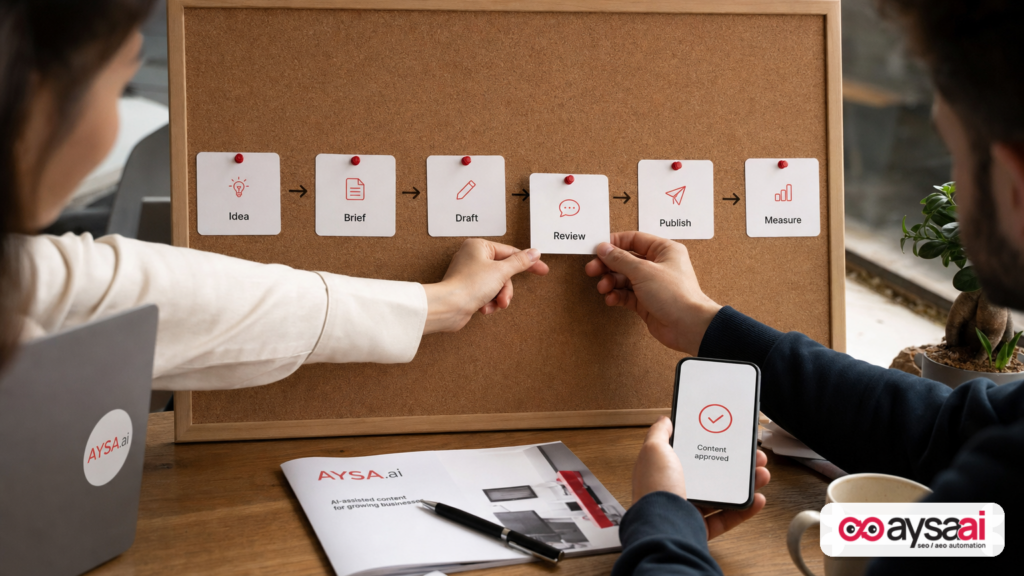
- AI sameness is a symptom, not the disease. If your content reads like everyone else’s, it’s usually because the AI doesn’t know your business. You’re feeding it topics, not truth.
- AI Ops is how you make AI accountable. It turns “someone tried a prompt” into a repeatable system with standards and checkpoints.
- First-party inputs are the differentiator. Customer questions, reviews, transcripts, product constraints, internal definitions—these are what make your content useful, specific, and citation-worthy.
- Governance is how you avoid silent brand damage. Not every error shows up as a ranking drop. Many show up as lost trust, confused leads, higher support load, and lower conversion rates.
- Execution matters more than ideation. The winning teams are the ones that consistently ship improvements—on-site updates, Internal linking, schema, content revisions—based on Monitoring and outcomes.
What changed: why AI content stopped being a shortcut
Businesses adopted AI writing tools because they promised leverage: more pages, more keywords, more coverage. For a while, many teams felt it working—especially in low-competition queries or underserved niches.
But two forces caught up quickly:
- The supply explosion. If everyone can publish “good enough” explanations at near-zero marginal cost, the internet fills up with “good enough” explanations. Search engines and users become pickier, not more generous.
- The trust problem. AI can be wrong, vague, or overconfident. Even when it’s factually accurate, it can be contextually useless: it doesn’t reflect what your customers actually ask, what your product actually does, or what your business actually stands for.
The result is what many teams now experience: a content library that grew, but outcomes didn’t.
Search Engine Journal’s webinar recap puts it plainly: many SEOs use AI, but only a small minority have a documented system governing that use (SEJ recap). That gap matters because AI doesn’t just accelerate writing—it accelerates inconsistency.
If the team has no shared context, no shared definition of quality, and no shared measurement model, AI becomes a multiplier of randomness. That’s not a growth strategy. That’s operational debt.
The shift: from “publishing more” to “operating better”
Here’s the uncomfortable truth: your competitors can buy the same AI tools tomorrow. If your “strategy” is a tool choice, it’s not strategy.
In practice, winning in SEO in 2026 looks less like an assembly line and more like an operations discipline:
- Inputs are standardized (what we feed AI, and what we never let it invent).
- Outputs are measured against outcomes (not just “did it publish”).
- Quality improves over time via feedback loops (and weak pages are revised or removed).
- Tool changes don’t break the system (you can swap models without losing your process).
This is why the four-layer AI Ops model matters. It gives you a way to build an advantage that compounds—because it’s made of assets and practices your competitor can’t copy overnight.
Layer 1 — Knowledge: the only real moat in AI content
Most AI content is generic for a simple reason: the model starts from a generic place. It knows the public web (in some form), but it doesn’t know your internal reality.
The “knowledge layer” is your answer: a documented, versioned, company-specific source of truth that powers everything you publish.
What it is (in plain English)
A knowledge layer is not just “links to your website.” It’s the private context that makes your brand meaningfully different:
- Positioning: who you serve, who you don’t, the alternatives you replace, the outcomes you guarantee (and those you don’t).
- Product truth: features, limitations, pricing logic, setup requirements, edge cases, compatibility.
- Customer language: the phrases customers use in calls, emails, chats, reviews, and tickets.
- Proof: anonymized results, case study patterns, before/after stories, common objections and resolutions.
- Policies: refund rules, shipping/returns, compliance rules, medical/legal disclaimers, service area definitions.
- Brand voice: what you sound like and what you never sound like (tone, reading level, taboo claims).
SEJ’s recap emphasizes that feeding AI only public site links is a start, not enough, because the highest-value context is what isn’t already public (source).
Why first-party data changes everything
If there’s one idea I want SMEs to internalize, it’s this:
First-party data is how you escape the commodity trap.
AI trained on public information can only produce public-shaped content. But your business has information the public web doesn’t:
- What prospects misunderstand before they buy
- What makes customers churn
- Which “best practices” don’t work in your niche
- How real-world constraints change the advice
This is exactly the kind of specificity that makes a page useful to a human—and therefore more likely to perform in search and be referenced in AI answers.
To keep this editorial honest: I’m not claiming “first-party data guarantees rankings.” No one can guarantee that. But it reliably improves what you can control: relevance, usefulness, differentiation, and conversion clarity.
A practical knowledge-layer starter kit (what to document)
If you’re an SME and you want a doable starting point, build these assets first:
- One-page positioning doc: audience, problem, unique angle, proof points, competitors/substitutes.
- Offer truth table: what’s included, excluded, prerequisites, limitations, typical timelines.
- Top 25 customer questions: pulled from calls/emails, not brainstorming.
- Objections library: “Is it worth it?” “Can you integrate with X?” “What if Y happens?” and your real answers.
- Claims policy: what you can say, what needs substantiation, what is prohibited.
- Voice + style rules: reading level, examples to use, examples to avoid.
Put it somewhere versioned and shared (even a controlled doc repository). The medium matters less than the discipline: one source of truth, updated as the business changes.
Layer 2 — Workflow: turn good prompts into production standards
AI content fails inside teams because each person invents their own way of working. That’s not just inefficient—it makes quality unpredictable. And unpredictable quality becomes a business risk when you publish at scale.
The workflow layer is how you make output consistent, trainable, and improvable.
What a real workflow includes
- Content brief templates that force clarity: audience, intent, promise, proof, conversion goal.
- Prompt libraries treated like production assets (versioned, updated, reviewed), not personal hacks.
- Drafting steps that separate structure from prose (outline first, then sections, then final polish).
- Required inputs from the knowledge layer (e.g., include “limitations” section; include “pricing context” section).
- Handoffs between roles (SME → writer → editor → SEO → publisher).
One of the strongest lines from the SEJ recap is essentially: you can’t “prompt” your way out of missing context (SEJ). I’ll extend that: you can’t prompt your way out of a missing workflow either.
A workflow example SMEs can run (without a big team)
If you have only one marketer—or you’re the owner doing marketing—use a lightweight SOP:
- Pick an outcome: “book a consultation,” “request a quote,” “start a trial.”
- Pick the audience stage: problem-aware, solution-aware, vendor comparison, post-purchase.
- Pull 3 first-party inputs: one customer question, one objection, one real constraint.
- Generate outline + angle: AI proposes structure, you approve the promise.
- Draft with embedded truth: AI writes sections using your knowledge layer; you insert specifics.
- Run a QA checklist: accuracy, tone, claims, conversion clarity, internal links, schema needs.
- Publish and measure: not only Impressions—engagement and conversions.
- Revise at 30 days: improve based on what users did, not what you hoped they’d do.
Layer 3 — Governance: quality control that scales (without slowing you down)
Governance is where many teams panic. They hear “governance” and picture meetings, bottlenecks, and bureaucracy.
But in AI-era SEO, governance is just the minimum set of controls that prevents you from publishing liabilities at machine speed.
What can go wrong if you skip it
- Brand drift: 50 pages later, you sound like a different company.
- Silent inaccuracies: the content is “reasonable,” but wrong in crucial details (pricing, eligibility, limitations).
- Compliance exposure: prohibited claims slip in (especially in health, finance, legal).
- Conversion confusion: pages rank but don’t convert because they don’t match your actual offer.
- Maintenance overload: you spend months fixing content you rushed out.
SEJ’s recap highlights the idea of review checkpoints and feedback loops that evolve as trust builds (source). That’s the right mental model: governance is not permanent friction. It’s temporary scaffolding until quality becomes predictable.
A simple QA checklist (start here)
Before publishing, check:
- Truth: Does every factual claim match your product/service reality?
- Specificity: Did we include at least 3 pieces of first-party context?
- Intent match: Does the page satisfy what the searcher actually wants at that stage?
- Risk controls: Any regulated claims? Any missing disclaimers?
- UX basics: Clear headings, scannable sections, real examples.
- Conversion clarity: What should the reader do next, and is that CTA real?
Layer 4 — Application: models and tools should be swappable
Tools matter—but they’re the least defensible layer.
The SEJ recap makes an important operational recommendation: stay model-agnostic so you can swap engines without rebuilding the operation (SEJ).
That’s correct for two reasons:
- Model performance shifts over time. What’s “best” this quarter may not be best next quarter.
- Your assets should outlive the tool. Your knowledge layer, briefs, QA checklists, and measurement scorecards are long-term assets.
In practice, this means your system should be able to handle different writing tools without rewriting how your business works.
Measurement: stop counting articles, start counting outcomes
AI tempted teams into a vanity metric: output volume.
But the business doesn’t pay you for publishing. It pays you for outcomes.
What to measure instead (even if you’re not an analyst)
You don’t need a perfect Attribution model to be more honest than “we published 40 posts.” Start with:
- Engagement signals: Are people actually reading? (Average engagement time, scroll depth if available, repeat views.)
- Conversion signals: Form submits, calls, bookings, trial starts, quote requests.
- Assisted conversions: Pages that introduce the brand and later influence conversions.
- Content maintenance cost: How often do you need to fix inaccuracies, support tickets, or misunderstandings caused by content?
SEJ’s recap points to using GA4 engagement signals beyond Search Console’s impressions and Clicks to judge whether content is helping or hurting (source).
That’s the right direction. Search Console is great for visibility. GA4 (or your analytics) is where you judge value.
A simple outcome scorecard (no fancy dashboards required)
For each page, track monthly:
- Search impressions + clicks (visibility)
- Average engagement time + views per user (usefulness)
- Primary conversion rate (business impact)
- Qualitative notes from sales/support (truth + alignment)
Then make a decision: expand, refine, consolidate, or remove. That last one matters: pruning weak pages is often healthier than letting a mediocre library grow forever.
A concrete SME scenario: the local clinic that “scaled content” and lost trust
Let’s make this real.
Imagine a mid-sized local clinic with three locations. The owner hears, “AI can write your blog.” They assign an admin and a freelancer to publish 10 posts/week: conditions, treatments, FAQs, “what to expect.” Traffic rises modestly at first.
Then the problems show up:
- Patients arrive expecting services the clinic doesn’t offer (because the AI wrote generic “we provide…” language).
- The content describes timelines that don’t match the clinic’s scheduling reality.
- Medical claims are overconfident or poorly phrased.
- The phone team gets longer calls (people are confused), not better leads.
No dramatic Google penalty. No obvious “SEO disaster.” Just a slow bleed: trust erosion, staff time wasted, and leads that don’t convert.
Here’s how AI Ops fixes it:
Knowledge layer for the clinic
- Service matrix per location (what’s offered where)
- Intake rules and contraindications (what requires referral)
- Common patient misconceptions from call notes
- Approved language + disclaimers
Workflow layer for the clinic
- Every post starts with a “patient intent” and “next step”
- Required section: “Is this right for you?” (with real constraints)
- Location-specific internal links (where applicable)
Governance layer for the clinic
- Medical review checkpoint for risk-sensitive pages
- Claims checklist (no outcomes promised without nuance)
- Quarterly audit of top pages for accuracy and conversion quality
The clinic may publish fewer posts, but each one is more correct, more specific, and more likely to produce qualified bookings.
What agencies must rethink in 2026
Agencies are under pressure from two sides:
- Clients expect faster output because “AI makes it fast.”
- Search and users expect more differentiation because “AI made everything the same.”
The agencies that win will stop selling content volume and start selling operations outcomes.
New deliverables that matter more than “X blog posts/month”
- Knowledge-layer buildout: structured assets and a cadence to keep them fresh.
- Prompt + template systems: maintained like code, not like copy.
- Governance frameworks: QA checklists, escalation rules, revision SLAs.
- Measurement scorecards: per-page decisions, not just monthly traffic charts.
- Execution velocity: the ability to implement site changes quickly and safely.
In other words: agencies must become system builders, not content factories.
Where AYSA fits: approved execution for AI-era SEO/AEO/GEO
AI Ops fails when it stays theoretical.
You can build a gorgeous knowledge layer and a disciplined workflow, but if the improvements never ship—if the site isn’t updated, internal links aren’t fixed, pages aren’t refreshed, schema isn’t applied, thin content isn’t consolidated—you don’t get compounding returns.
That’s where AYSA is designed to fit: as an execution system that helps you move from “we should” to “it’s done.”
- Monitor what matters: Use Monitoring to keep an eye on visibility and site changes that impact performance.
- Prepare recommended changes: Turn insights into a concrete set of on-site updates—content revisions, internal linking improvements, page enhancements.
- Ask for approval: Keep humans in control. AI can propose; your business approves.
- Execute accepted improvements: Ship changes without getting stuck in endless backlogs.
This matters for SMEs because the biggest SEO killer is not a lack of ideas. It’s a lack of follow-through.
If you want the bigger picture of how search visibility evolves in AI-driven experiences, start here: AI Search Visibility. For a view of AI-powered SEO tooling, see AI SEO Tools.
How AYSA supports each AI Ops layer
- Knowledge: AYSA benefits when your brand truth is documented—because recommendations and changes align better when inputs are clear.
- Workflow: AYSA operationalizes repeatable tasks: monitoring → propose → approve → execute.
- Governance: The approval step is governance in action—humans remain accountable for what publishes.
- Application: As tools evolve, your execution system remains consistent.
To explore fit and cost, see Pricing. For more playbooks like this, visit the AYSA blog.
A 30-day AI Ops action plan you can actually run
You don’t need a “transformation program.” You need a sequence that produces a working system quickly.
Days 1–7: Audit reality (not intentions)
- List every place AI is used: drafting, rewriting, briefs, meta descriptions, internal linking, FAQs.
- Collect 10 recently published AI-assisted pages.
- Score them using a simple rubric: truth, specificity, intent match, brand voice, conversion clarity.
- Identify failure patterns (generic intros, missing constraints, vague CTAs, repetitive structure).
Days 8–15: Build the minimum viable knowledge layer
- Write the one-page positioning doc.
- Create a “truth table” for your offer (included/excluded/limits).
- Extract top customer questions from real interactions.
- Draft a claims policy and a tone guide.
Days 16–23: Standardize workflow
- Create one content brief template.
- Create 3–5 reusable prompt templates (outline, rewrite with constraints, FAQ generation with proof, editor pass).
- Define roles and checkpoints (even if one person wears multiple hats).
Days 24–30: Add governance + measurement
- Implement the QA checklist.
- Pick 5 pages to improve (don’t only create new ones).
- Set up a monthly scorecard for visibility, engagement, and conversions.
- Decide revision rules: e.g., “If engagement is low for 60 days, revise; if it misleads, fix immediately.”
Then repeat monthly: build knowledge → publish → measure → revise. That’s the compounding loop.
What to do next
- Stop the content treadmill for one week. Audit 10 pages and write down what “generic” looks like on your site.
- Build your minimum knowledge layer. Start with positioning + offer truth table + customer questions.
- Standardize a workflow. One brief template, one QA checklist, one measurement scorecard.
- Shift your KPI. Track conversions and engagement per page, not just traffic and output.
- Invest in execution. Use a system that monitors and helps ship improvements. If you want to see how AYSA approaches this, start with Monitoring and AI Search Visibility.
Sources and further reading
- Search Engine Journal — “The 4-Layer AI Ops Playbook: From Better AI Outputs To Strong SEO Results” (recap): searchenginejournal.com: 579419
- Search Engine Journal — SEO section (ongoing coverage and context): Search Engine Journal SEO
- Search Engine Journal — Webinars (original webinar context and related sessions): searchenginejournal.com: Webinar
- Search Engine Journal — Google Algorithm Updates hub (broader search ecosystem context): Search Engine Journal Google Algorithm History
- AYSA — AI Search Visibility: AI Search Visibility
- AYSA — AI SEO Tools: AI SEO Tools
- AYSA — Monitoring: AYSA Monitoring
- AYSA — Pricing: AYSA Pricing
- AYSA — Blog: AYSA Blog
Note on sources: The SEJ recap did not include direct links to primary sources (e.g., Google documentation) inside the supplied research context. Where this article makes broader strategic recommendations, they are framed as analysis and operational guidance rather than claims of confirmed platform behavior.
Continue the AI search topic inside AYSA.
Use these pages to connect the article with AI SEO tools, AI visibility monitoring, AI Overviews and approved website execution.
Turn this topic into a website action plan.
Use these AYSA hubs to move from reading to technical fixes, AI visibility monitoring, research, glossary context and approval-first SEO execution.