
Bing’s Topics Portfolio: How To Turn AI Citation Gaps Into A Practical AEO/GEO Growth Plan
Bing Webmaster Tools now groups AI-cited queries into topics and surfaces “opportunity queries” where other sites are cited but yours isn’t. Here’s how to turn that beta report into a durable AEO/GEO execution plan for SMEs and agencies—without chasing noisy numbers.

AI Search is no longer a side-channel. For a growing number of buyers, the “search result” is an AI answer with citations—and the brands that get cited capture demand earlier, build trust faster, and often win the click when the user decides to go deeper.
Microsoft just made that reality easier to manage. In Bing Webmaster Tools, a beta feature called Topics Portfolio now groups the queries your site is cited for in AI answers into broader topics and surfaces “opportunity queries”—queries where Bing’s AI cites other sites but doesn’t cite yours. That is a meaningful shift: instead of asking you to interpret hundreds of isolated queries, Bing is pushing you toward a topic-level operating model.
This article explains what changed, why it matters (even if you don’t care about Bing “market share” debates), what can go wrong with the data, and how to turn Topics Portfolio into a practical AEO/GEO Execution Plan for SMEs and agencies. I’ll also explain where AYSA fits: Monitoring signals, preparing improvements, asking for approval, and executing accepted website changes safely and consistently.
Concise summary
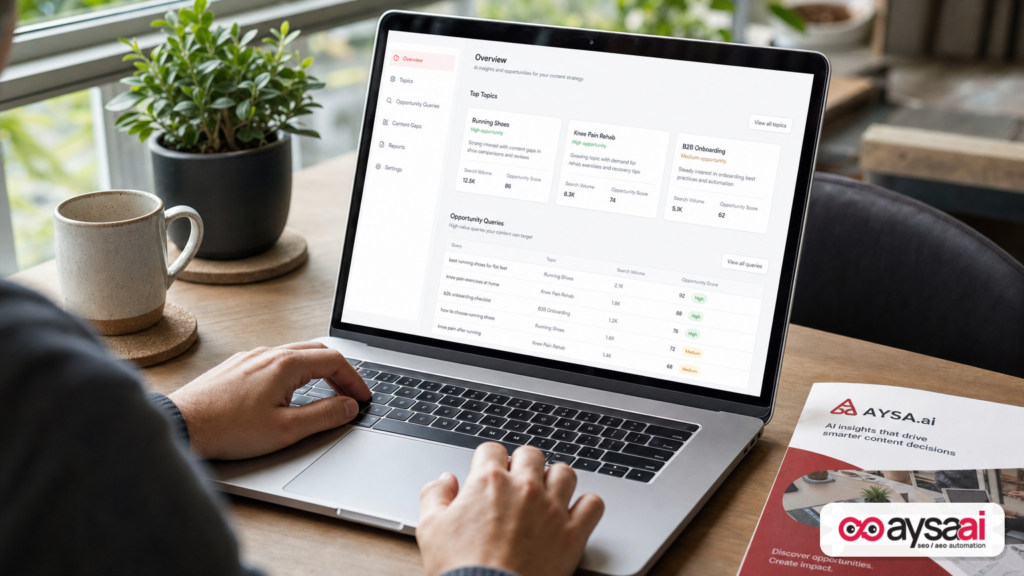
- What’s new: Bing’s AI Performance report now includes Topics Portfolio (beta), which groups AI-cited “grounding queries” into topics and shows opportunity queries where other sites are cited and you aren’t.
- Why it matters: It’s a built-in, search-native way to identify coverage gaps for AI answers—moving beyond Keyword lists into topic strategy.
- What to do: Use Topics Portfolio to (1) choose the right topics, (2) build citation-worthy pages, (3) strengthen entity + evidence signals, (4) improve Crawlability and internal discovery, (5) measure directional lift over time.
- What to ignore: Treat the metrics as directional. Don’t chase competitor-branded queries or “opportunities” that don’t align with your product, geography, or compliance constraints.
Key takeaways
- AI search visibility is becoming topic-portfolio management, not a never-ending list of keywords.
- “Opportunity queries” are best used as content brief starters—not as a precise forecasting model.
- The competitive advantage will increasingly go to teams that can execute improvements quickly and safely (technical fixes, content refreshes, Internal linking, schema, and evidence upgrades).
- Even if you’re primarily focused on Google, the discipline you build from Bing’s Topics Portfolio translates directly to AI-driven discovery patterns across search products.
Table of contents

- What changed: Bing adds Topics Portfolio to AI Performance
- What Bing just added: Topics Portfolio + opportunity queries
- Grounding queries, citations, and why “topic” is the right abstraction
- The new KPI: from rankings to citation-worthy coverage
- Beta limits and data traps (and how to avoid bad decisions)
- A practical workflow: turning topic gaps into a publish/refresh plan
- What “citation-worthy” content looks like in 2026–2027
- Technical foundations that quietly decide whether you get cited
- Measurement: how to evaluate progress without pretending the numbers are exact
- SME scenario: a local clinic competing for high-intent AI answers
- Agency implications: new deliverables, new reporting, new retention
- Where AYSA fits: monitoring → recommendations → approved execution
- What to do next (action list)
- Sources and further reading
What changed: Bing adds Topics Portfolio to AI Performance
Microsoft announced a beta feature called Topics Portfolio inside the AI Performance report in Bing Webmaster Tools. According to Search Engine Journal’s coverage, the view:
- Groups the queries your site is cited for in AI answers into broader topics.
- Provides topic-level context (estimated topic size, how many sites are cited, and how many grounding queries exist in the topic).
- Lists opportunity queries where other sites are cited but your site is not.
That last bullet is the big deal. It converts “AI visibility” from a passive report (“here are your citations”) into an actionable backlog (“here are queries in your topics where you’re missing”). It also helps teams stop thinking in isolated keywords and start working in topic clusters—closer to how AI systems retrieve and summarize information.
External source: Search Engine Journal’s report on this update is here: Bing Webmaster Tools Sorts AI Search Queries Into Topics.
What Bing just added: Topics Portfolio + “Opportunity Queries”
Topics Portfolio appears as a new tab in Bing Webmaster Tools’ AI Performance area (alongside “Citations & Pages,” per the report). The first screen focuses on topics where Bing considers your site to have a “meaningful” presence. You’ll see three high-level metrics for each topic:
- Topic size: An estimate of total citation volume across all sites for that topic in the chosen time period (Microsoft frames this as a demand signal).
- Sites cited: Approximately how many different sites show up in citations within that topic.
- Queries: Approximately how many different grounding queries exist inside the topic.
Below the topics table, Bing shows Top Opportunity Queries: queries pulled from across your topics where other sites are being cited but you aren’t. The citation counts are presented as ranges, not exact numbers.
Clicking into a topic reveals:
- Topic size, your citations in that topic, and query count.
- A list of queries where you are cited.
- A list of opportunity queries where you’re not cited.
Time windows are limited to one, two, or three months (per the coverage), and Microsoft warns that the data is directional.
Grounding queries, citations, and why “topic” is the right abstraction
Microsoft uses a term that matters for how you think about optimization: grounding queries. As described in the Search Engine Journal write-up, grounding queries are the search terms Bing’s AI uses to locate content to cite in its answers across Copilot, Bing AI summaries, and partner integrations.
Why does that matter?
- AI answers are compositional. The AI isn’t “ranking pages” in the same way as classic search results. It’s assembling an answer from sources it deems relevant and trustworthy for the intent.
- The “query” is often a proxy for a task. Many modern searches are really tasks (“choose a running shoe for flat feet,” “is physical therapy covered by insurance,” “how to reduce return rates for apparel ecommerce”). Topic clustering is closer to task clustering than keyword tracking.
- Citations are a new surface area of competition. You might be visible in classic organic listings but still not be chosen as a citation source, because the AI is looking for a different content shape: concise definitions, comparisons, evidence, step-by-step procedures, or authoritative explanations.
Topics Portfolio pushes you to manage coverage at the topic level. That’s the right direction. Keyword lists are not going away, but they are becoming less sufficient as the primary planning model for AI-influenced search.
The new KPI: From rankings to “citation-worthy coverage”
Most SMEs still operate with a mental model like this:
- Pick keywords → write a page → wait for rankings → track sessions → report growth.
AI answer experiences disrupt that model in two ways:
- The click may happen later—or not at all. Users may get enough information in the AI answer to move forward without visiting a website, or they may click only when they want details, pricing, booking, or proof.
- The “winner” is often the cited source. Being cited is a trust signal and a discovery channel. It can influence brand recall and downstream conversions even when last-click attribution is messy.
So the KPI shifts from “Are we #1?” to “Are we present in the AI answer for the tasks our buyers ask about?” That presence is strongly connected to being cited.
In practice, I like to frame the KPI as:
- Citation-worthy coverage: Do we have content that is structured, specific, and evidence-backed enough that an AI system would confidently cite it?
- Topic breadth + depth: Are we covering the topic from the angles the market actually asks about?
- Consistency over time: Are we shipping improvements weekly, not quarterly?
Bing’s Topics Portfolio doesn’t solve measurement completely (it’s still beta, and estimates are directional). But it does provide a concrete operational artifact: a backlog of missing queries inside your own topics.
Beta limits and data traps (and how to avoid bad decisions)
Microsoft explicitly cautions that Topics Portfolio is AI-generated and can misclassify queries. It may also surface branded searches (including competitor brand queries) as “opportunities.” And Bing frames the counts as directional signals, not a ledger.
Here are the main traps I see businesses fall into with reports like this—and how to avoid them.
Trap #1: Treating estimated ranges like forecast-grade numbers
If citation volume is shown in ranges, that’s a hint: you should not build a forecast that promises “X citations next month.” Use the ranges to compare topics and prioritize effort, not to create false precision.
What to do instead: Use a simple prioritization score that blends:
- Topic relevance to your product/service margin
- Topic size (directional demand)
- Competitive intensity (sites cited)
- Your ability to ship improvements quickly (content + technical)
Trap #2: Chasing competitor-branded “opportunities”
If you’re a running shoe retailer and Bing shows “CompetitorBrand running shoes” as an opportunity, that doesn’t automatically mean you should publish pages targeting that brand. In many businesses, that’s low-quality effort, brand-risky, or legally/compliantly complicated.
What to do instead: Apply filters:
- Brand filter: exclude competitor brand queries unless you have a legitimate comparison page strategy
- Geo filter: exclude regions you don’t serve
- Intent filter: exclude intents you don’t monetize or support (e.g., academic research if you sell consumer products)
Trap #3: Assuming you’re “invisible” if you don’t see Topics Portfolio
Per the report, Topics Portfolio only shows if Bing has enough data on your site, and topics with limited site presence or ecosystem activity may not appear—meaning smaller sites might see fewer items or not see the feature at all.
What to do instead: If you don’t see it, focus on fundamentals:
- Make sure Bing can crawl and understand your content
- Publish a clear topic hub + supporting pages
- Improve internal linking so your important pages are discoverable
- Strengthen proof signals (author identity, references, policies)
Trap #4: Writing “AI bait” content that hurts your brand
When teams chase AI visibility, they sometimes produce thin listicles, generic definitions, or templated pages that don’t reflect real expertise. That can damage conversion rates, reputation, and long-term organic performance.
What to do instead: Optimize for being a credible source. That means:
- Specificity (real steps, real constraints, real alternatives)
- Evidence (explain how you know what you know)
- Clarity (make key facts easy to extract)
A practical workflow: turning topic gaps into a publish/refresh plan
Here’s a workflow I’d recommend for SMEs and agencies using Topics Portfolio. It’s not complicated—but it does require discipline.
Step 1: Pick 3–7 “money topics,” not 50
Start with focus. Choose topics where:
- You have products/services with meaningful margin
- You can deliver on the promise (availability, geography, compliance)
- You can create or improve content quickly
Topics Portfolio helps you see where you already have “meaningful presence.” That’s usually the best place to start, because you’re not building from zero.
Step 2: Split opportunity queries into three buckets
For each topic’s opportunity queries, classify them:
- Build: you don’t have a page that directly answers the query/task
- Improve: you have a page, but it’s not structured or specific enough to be cited
- Ignore: competitor-branded, irrelevant, out-of-scope, or too risky
This seems obvious, but most teams skip it and end up with a bloated content backlog that never gets executed.
Step 3: Turn each target query into a “citation brief”
A citation brief is different from a classic SEO brief. It should include:
- Answer target: what would a concise, accurate AI answer include?
- Evidence plan: what will you cite or reference to support claims (policies, standards, primary sources)?
- Extraction points: where are the definitions, steps, pros/cons, comparisons, and constraints written clearly?
- Internal linking plan: what hub page supports the cluster, and how will supporting pages link back?
- Conversion bridge: what’s the next step for a user (quote, booking, demo, product page)?
Step 4: Execute in weekly cycles (refresh > net-new when possible)
Many sites already have relevant pages; they just need to be upgraded for AI citation readiness. Start with refreshes because they’re faster:
- Rewrite intros to answer the question immediately
- Add definitions, constraints, and comparisons
- Add a “when to choose X vs Y” section
- Add an FAQ that captures real variations of the task
- Improve internal linking and page discovery
Then publish net-new pages only for true gaps.
Step 5: Track directional lift, not perfection
Because the data is estimated and topic-based, your tracking should be pragmatic:
- Are you seeing more queries where you’re cited inside the topic?
- Are opportunity queries shrinking in the areas you invested in?
- Are leads/sales improving for the products tied to those topics?
What “citation-worthy” content looks like in 2026–2027
If you want to be cited, you need to be easy to cite. That sounds simplistic, but it’s a major gap for many businesses: their content may be “good marketing,” but not “good reference material.” AI systems lean on sources that are clear, structured, and confident.
Content patterns that tend to earn citations
- Definitions + distinctions: “What is X?” plus “X vs Y” plus “when X is not appropriate.”
- Step-by-step procedures: clear steps, prerequisites, and decision points.
- Comparison tables: feature comparisons, pros/cons, costs, timelines—written with real constraints.
- Buyer task coverage: content aligned to tasks like choosing, fixing, evaluating, or complying.
- Evidence-backed claims: linking to reputable sources when making factual statements (especially in health, finance, safety, or legal-adjacent topics).
Structure matters more than ever
For AI answers, structure isn’t “nice to have.” It’s part of retrieval. Even without speculating on Bing’s internal mechanisms beyond what Microsoft has shared, we can say this safely: content that is easy for machines to parse tends to be content that is easy to cite.
Practical structural upgrades:
- Use descriptive headings that mirror questions users ask
- Answer the question early, then expand
- Use lists and tables when they genuinely clarify
- Keep definitions and key constraints in one place
- Add “common mistakes” and “edge cases” sections (these often trigger citations)
Trust signals: don’t fake them—build them
Citations are, in practice, a form of trust transfer. Make it easy to trust your page:
- Clear author or editorial ownership (even for SMEs)
- Up-to-date timestamps where relevant
- Transparent policies (returns, shipping, cancellations, privacy, clinical disclaimers)
- Real-world specifics (service areas, supported conditions, product specs)
If you operate in regulated or sensitive spaces, be especially careful: don’t chase citations with overconfident claims you can’t support.
Technical foundations that quietly decide whether you get cited
When teams talk about AI search, they often jump straight to content. Content is crucial—but citations also depend on whether your site is technically easy to access, interpret, and trust.
Here are the technical areas that commonly block citation outcomes:
1) Crawlability and rendering
- Important pages blocked by robots.txt or noindex
- Over-reliance on client-side rendering that slows or breaks content discovery
- Duplicate URL parameters that waste crawl budget
2) Information architecture and internal linking
Topic clusters need visible pathways:
- A hub page that defines the topic and links to supporting pages
- Supporting pages that link back to the hub and to each other where relevant
- Consistent anchor text that describes what the page is actually about
3) Structured data (schema) as clarity, not decoration
I’m not going to promise that schema “guarantees” AI citations—no credible system works like that. But schema can improve clarity and reduce ambiguity about entities like organizations, products, local businesses, and FAQs.
If you’re already investing in content upgrades, it’s often worth aligning structured data accordingly—carefully and correctly.
4) Page experience and accessibility
Even when a user never clicks, crawlers still need to access and parse. Pages overloaded with popups, heavy scripts, or confusing layouts can reduce your chance of being selected as a clean reference source.
5) Canonicalization and duplication control
If you have many near-duplicate pages (location variants, faceted ecommerce, thin category pages), you can dilute signals. Consolidate and clarify what the primary source page is for a topic.
Measurement: how to evaluate progress without pretending the numbers are exact
Topics Portfolio is explicit about being directional. That’s not a flaw—it’s an honest reflection of how messy this ecosystem is right now.
A measurement model I trust for SMEs looks like this:
Leading indicators (weekly/biweekly)
- Number of pages refreshed or published for priority topics
- Internal linking completeness for each topic cluster
- Content quality checks completed (definitions, comparisons, FAQs, evidence)
Mid indicators (monthly)
- Directional changes in topic presence (more queries where you’re cited)
- Reduction in “obvious gap” opportunity queries (after you publish direct answers)
- Brand searches and assisted conversions (where you can measure them)
Business outcomes (quarterly)
- Leads, bookings, demos, revenue tied to the topic’s products/services
- Sales cycle acceleration (harder to measure, but real)
- Content production efficiency (time from insight → live change)
Where teams go wrong is waiting for perfect attribution. AI-assisted discovery will not always map cleanly to last-click sessions. Your job is to build presence where buyer intent exists and to ensure your website can capture demand when users do click.
A concrete SME scenario: A local clinic competing for high-intent AI answers
Let’s make this real with a scenario that mirrors what I see across local services.
Business: A 3-location physical therapy clinic.
Goal: More booked evaluations for runners and office workers.
Problem: They rank for some local terms, but they’re rarely cited in AI answers for questions like:
- “What are signs I need physical therapy for knee pain?”
- “How long does PT take for runner’s knee?”
- “PT vs chiropractor for lower back pain—what’s the difference?”
What Topics Portfolio might reveal (conceptually):
- A topic around “knee pain rehab” where they have some citations.
- Opportunity queries inside that topic where national health sites or other clinics are cited, but this clinic isn’t.
What the clinic should do next:
- Choose the topic: “knee pain rehab” and “running injury prevention.”
- Refresh existing pages: Add clear definitions, timelines, “when to see a professional,” and contraindications; include clinician review and updated dates where appropriate.
- Publish missing pages: Specific comparisons (PT vs rest, PT vs chiropractor), plus short Q&A pages tied to common tasks (return to running, stairs pain, desk posture).
- Improve internal linking: A hub page for running injuries that links to each supporting page; each supporting page links back and to booking.
- Build trust: Clear clinician bios, clinic policies, service areas, and careful language (avoid overpromising medical outcomes).
Expected result (directionally): More chances to be cited for task-based questions, and a better on-site experience for people who do click through and book.
This is the core point: Topics Portfolio is not just an SEO report. It’s a planning tool that can drive real operational changes in your marketing execution.
Agency implications: new deliverables, new reporting, new retention
If you run an agency, Topics Portfolio reinforces a trend that’s been building since AI answers became mainstream: the deliverable is shifting from “rankings + traffic” to “topic coverage + citation presence + execution velocity.”
What agencies should add to the monthly package
- Topic portfolio review: pick 3–5 topics to invest in each quarter
- Opportunity query triage: build / improve / ignore classification with rationale
- Citation briefs: a repeatable template for turning a query into a publishable asset
- Execution log: what was shipped and why (clients renew when they see consistent shipping)
Where agencies can get burned
- Overpromising precise outcomes from beta, directional reports
- Publishing thin content at scale to “cover” opportunity queries quickly
- Ignoring technical foundations and then blaming “AI volatility” for lack of results
AI search makes strategy more important—but it also makes operations decisive. The agency that can ship high-quality improvements every week will outperform the agency that delivers beautiful slides.
Where AYSA fits: Monitoring → Recommendations → Approved Execution
This is exactly the kind of environment AYSA is built for: a world where visibility depends on continuous improvement, but businesses still need safety, accountability, and human approval before changes go live.
At a high level, the workflow looks like this:
- Monitor: Track AI search visibility signals and site health trends (so you know where you’re gaining or losing ground). See: AYSA Monitoring.
- Prepare improvements: Turn topic opportunities into concrete, page-level recommendations (content refreshes, internal links, structural upgrades, technical fixes). Explore: AYSA AI SEO Tools.
- Ask for approval: Nothing ships silently. Teams review what will change and why.
- Execute accepted changes: Implement the approved updates consistently, without months of backlog. Learn more: AYSA AI Search Visibility.
This “approved execution” model matters because AI-era SEO/AEO/GEO is not a one-time project. It’s a system. When Bing (and others) surface opportunity gaps, the winners will be the businesses that can:
- Decide quickly what matters
- Ship improvements safely
- Maintain quality and brand standards
- Repeat weekly
If you’re evaluating whether to build this internally or with a platform-assisted approach, start by asking: How long does it take us today to go from “insight” to “change live on the website”? If the answer is measured in months, AI search will feel like chaos. If it’s measured in days, AI search becomes compounding advantage.
For teams that want to explore what this looks like in practice, start with the product overview on AYSA’s blog and review packaging on AYSA Pricing.
What to do next (action list)
- Open Bing Webmaster Tools → AI Performance → Topics Portfolio (if available) and export/record the top topics and top opportunity queries.
- Pick 3–7 priority topics aligned to revenue and real customer intent.
- Triage opportunity queries into build / improve / ignore. Be ruthless about ignoring brand-noise and irrelevant intents.
- Refresh before you publish net-new: upgrade existing pages with better structure, clearer answers, comparisons, and evidence.
- Strengthen internal linking so topic hubs and supporting pages reinforce each other.
- Fix technical blockers that prevent crawling, understanding, or consolidation (indexation, canonicals, duplication, rendering).
- Review monthly: Did topic presence expand? Did the “missing” list shrink where you invested?
- Operationalize execution: adopt an approved-execution workflow so improvements ship weekly, not quarterly.
Sources and further reading
- Search Engine Journal: Bing Webmaster Tools Sorts AI Search Queries Into Topics
- Search Engine Journal: AI Search coverage
- Search Engine Journal: SEO coverage
- Search Engine Journal: Technical SEO coverage
- Search Engine Journal: Local SEO coverage
- Search Engine Journal: Enterprise SEO coverage
- Search Engine Journal: Links & PR coverage
AYSA resources referenced in this article:
Continue the AI search topic inside AYSA.
Use these pages to connect the article with AI SEO tools, AI visibility monitoring, AI Overviews and approved website execution.
Turn this topic into a website action plan.
Use these AYSA hubs to move from reading to technical fixes, AI visibility monitoring, research, glossary context and approval-first SEO execution.