Google’s AI Opt-Out Just Got More Expensive: What It Means for Top Stories, Publishers, and Every Business That Relies on Search
Google is increasingly blending “Top Stories” into AI Overviews, which could turn an AI opt-out decision into a visibility decision. Here’s what changed, why it matters beyond news, and a practical playbook to protect traffic and brand demand—without losing control of your content.

Google’s relationship with publishers has always carried a quiet tension: you want distribution, Google wants data, and the user wants speed. But a new design pattern is turning that tension into a hard operational choice. According to reporting in Search Engine Journal citing NewzDash tracking, Google is sometimes placing the Top Stories carousel inside AI Overviews instead of showing it as a separate module lower on the page.
If that pattern expands, a decision that used to be framed as “do we let Google use our content in AI summaries?” starts to become “do we accept AI participation to keep premium visibility?” That matters for publishers first, but it won’t stop there. Any business that depends on discovery from Google—ecommerce brands, clinics, SaaS, local services, agencies—should treat this as a preview of how AI Search will bundle, gate, and re-price attention.
I’m Marius Dosinescu, and at AYSA.ai we build systems to monitor and execute SEO/AEO/GEO changes with an approval layer—because in AI search, the gap between “we noticed it” and “we shipped the fix” is where revenue disappears.
Concise summary
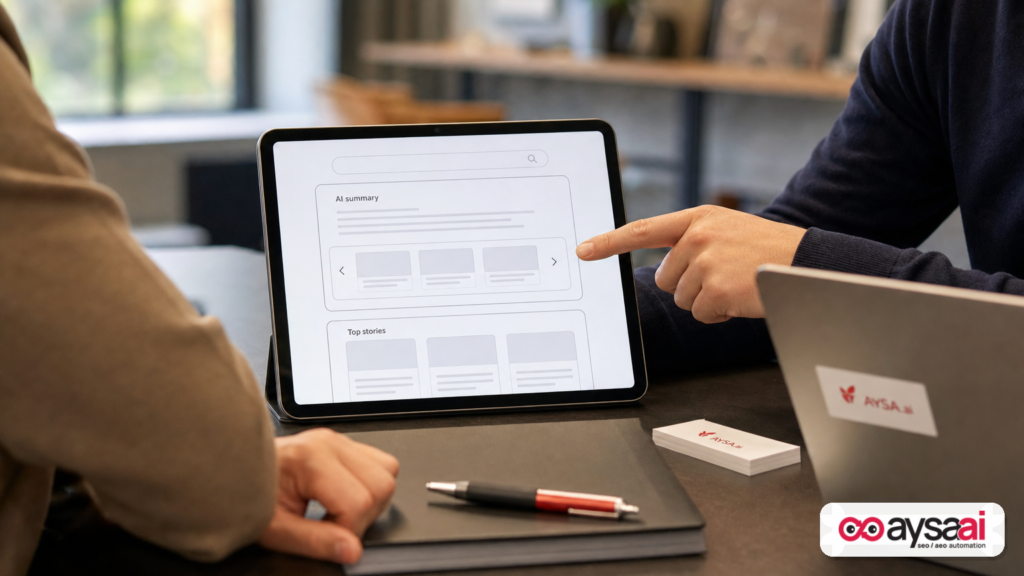
- What changed: Top Stories can appear inside AI Overviews for some queries, meaning one placement replaces the other (not additive), based on third-party tracking referenced by SEJ.
- Why it matters: If the carousel is nested inside an AI feature, the AI opt-out setting may effectively become a visibility opt-out for that placement—especially for news content.
- What to do: Treat AI search participation as a portfolio decision: segment content, quantify risk, monitor visibility shifts, and build an execution pipeline to respond quickly.
- Where AYSA fits: Monitoring catches changes; AYSA then prepares fixes, asks for approval, and executes accepted changes—so you don’t get stuck in analysis while SERPs move.
Table of contents

- What Changed: “Top Stories” Can Appear Inside AI Overviews
- Why This Is Happening Now (And Why It’s a Pattern, Not a One-Off)
- Google’s AI Opt-Out: What We Know vs. What We’re Inferring
- Google-Extended vs AI Overviews Opt-Out: Don’t Confuse the Controls
- The Real Decision: Control vs Distribution (Not Just a Publisher Problem)
- How AI Overviews Change Click Behavior (Even Without “Traffic Collapse” Headlines)
- What Can Go Wrong: 10 Practical Risks of AI-Nested SERP Features
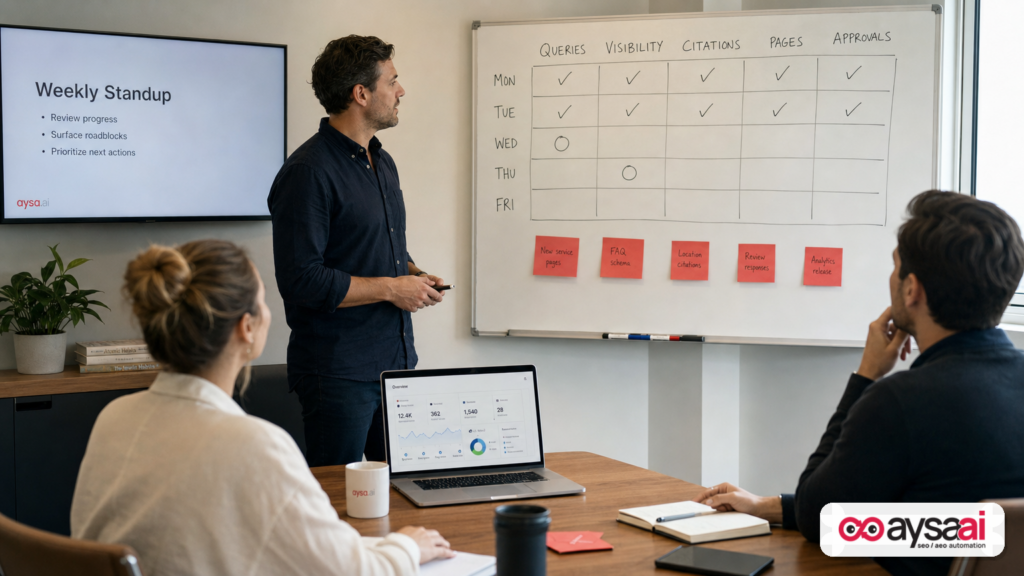
- A Practical Monitoring Framework: What You Should Track Weekly
- Action Plan: A Step-by-Step Playbook for Publishers, SMEs, and Agencies
- Concrete SME Scenario: A Local Clinic vs AI Summaries
- What Agencies Should Rethink: Deliverables, Reporting, and “Visibility Engineering”
- Where AYSA Fits: Monitoring + Approved Execution
- What to do next
- Sources and further reading
What Changed: “Top Stories” Can Appear Inside AI Overviews
Historically, Google’s search results for newsy queries often included a visible, dedicated Top Stories carousel—an obvious module that stood out and reliably drove Clicks for eligible publishers.
Now, third-party tracking referenced by SEJ reports a shift: Google is sometimes showing the Top Stories carousel inside the AI Overview panel. In those tracked cases, it appears to replace the usual separate Top Stories module instead of adding a second opportunity.
Even if you’re not a publisher, pay attention to the product logic here:
- Google is consolidating key SERP modules into AI-driven containers.
- When features move into AI, your visibility becomes dependent on AI participation rules.
- What used to be “ranking for module X” becomes “being allowed inside AI feature Y.”
This is the bigger story: AI isn’t only summarizing. It’s becoming the layout layer that other features live inside.
Why This Is Happening Now (And Why It’s a Pattern, Not a One-Off)
Google is optimizing for a single outcome: keep the user satisfied while keeping the user on Google. AI Overviews are one of the cleanest ways to do that because they can:
- Answer quickly for simple intent.
- Guide the user for complex intent.
- Provide “confidence scaffolding” via links or carousels, when necessary.
If you’re Google, nesting Top Stories inside the AI Overview has obvious benefits:
- Interface simplification: fewer distinct modules, less clutter.
- Stronger AI adoption: AI becomes the default “frame” for the SERP.
- Controlled click distribution: when Google decides which links to surface, where, and how prominently, it can stabilize user behavior.
From the publisher and business side, the risks are equally obvious: a new dependency forms, and the rules can change faster than you can update strategy decks.
Google’s AI Opt-Out: What We Know vs. What We’re Inferring
SEJ reports that Google introduced an AI opt-out control in Search Console that applies to AI features including AI Overviews, and that Google began taking that setting into account starting June 17 (per Google’s communications referenced in the SEJ piece). The key operational question raised: if Top Stories is inside AI Overviews, does opting out remove you from that Top Stories carousel placement?
We do not have an official, explicit “yes/no” statement (in the supplied context) that clarifies how nested modules are treated when the parent feature is opted out of. The SEJ article notes this ambiguity and frames the publisher interpretation as high confidence but not yet proven.
So here’s the disciplined way to think about it:
- Known: Google states that opting out prevents your content and links from appearing in the covered AI features.
- Unknown: Whether a carousel nested within an AI Overview is treated as “part of the feature” or has separate eligibility logic.
- Likely (but unverified): If the carousel is rendered inside the AI Overview container, the simplest implementation is that it inherits the opt-out behavior.
In business terms, the risk isn’t that Google is “punishing” anyone. The risk is the mechanics of product design: feature nesting tends to inherit the parent’s rules unless explicitly carved out.
Google-Extended vs AI Overviews Opt-Out: Don’t Confuse the Controls
SEJ also highlights a common confusion: publishers mixing up Google-Extended with AI feature opt-outs. Google-Extended is discussed on Google’s crawler documentation pages (as referenced in the SEJ article), and it is positioned as a control related to whether crawled content is used for training or grounding Gemini-related applications—not a broad “keep me out of Google Search” switch.
In plain English:
- Google-Extended: A control related to Gemini model training and certain Gemini app grounding use cases (per Google’s documentation referenced by SEJ). It does not automatically remove you from Search or from AI Overviews.
- Search Console AI opt-out setting: A Search feature control intended to keep your content/links out of covered AI search features (as described in the SEJ reporting).
The strategic implication: many teams may believe they “opted out,” while they only changed a crawler directive that doesn’t affect the AI search surfaces they care about. That’s not a moral failure—it’s a governance problem. And governance problems become revenue problems fast.
The Real Decision: Control vs Distribution (And Why This Is Not Just a Publisher Problem)
Publishers feel this first because their business model is tied to pageviews and ad inventory. But for SMEs and non-media brands, the same tension exists—just with different currency:
- Publishers: traffic, subscriptions, CPMs, licensing.
- Ecommerce brands: product discovery, category page demand, comparison traffic.
- Clinics and local services: appointment leads, insurance-specific queries, “best near me” demand.
- SaaS: demo signups, category leadership, integration searches.
The decision you’ll increasingly be forced to make is not “Do I like AI?” It’s:
- Which parts of my content are commoditized answers that AI will summarize anyway?
- Which parts are brand-differentiated assets that I can defend with depth, proof, and experience?
- Where do I need distribution even if it means giving up some click share?
That’s why I call this “visibility engineering.” You can’t treat Google’s AI layer as a single toggle. You need segmentation, measurement, and operational speed.
How AI Overviews Change Click Behavior (Even Without “Traffic Collapse” Headlines)
AI Overviews change search behavior in three ways that most businesses underestimate:
1) They absorb the “quick win” clicks
If a user can get the gist without leaving Google, they will. The click that disappears first is the one you used to win by being “good enough.” AI makes “good enough” invisible.
2) They restructure what “ranking” means
Ranking used to mean ordering of blue links plus some modules. AI introduces a new layer where the user’s journey can be completed or redirected before they ever evaluate your listing.
3) They introduce citation competition
In AI search, you’re competing to be:
- summarized,
- cited,
- recommended,
- or surfaced in a carousel inside a generated answer.
This is AEO (Answer Engine Optimization) and GEO (Generative Engine Optimization) territory. The fundamentals still matter—crawl, index, relevance, authority—but the success outcome expands: visibility isn’t only a click; it’s also a mention, a citation, a “next step” suggestion.
That’s why we built AYSA AI Search Visibility as a dedicated layer: you need to see where you are being surfaced across AI-driven experiences and then act.
What Can Go Wrong: 10 Practical Risks of AI-Nested SERP Features
Let’s get specific. When Google nests modules like Top Stories into AI Overviews, the downstream risks include:
1) Hidden eligibility changes
You can lose a premium placement without “dropping rankings” in the classic sense. Your pages may still rank—just not where users look.
2) Governance confusion (wrong opt-out, wrong directive, wrong scope)
Teams set one control (e.g., Google-Extended) and assume it affects AI Overviews. Or they opt out in Search Console without realizing which business units depend on that visibility.
3) Measurement blind spots
Many organizations still treat Search Console impressions as the north star, even though AI surfaces can change how impressions are counted and how clicks distribute.
4) “The carousel is the click”
If the Top Stories carousel becomes the main pathway to publishers inside AI results, opting out could reduce discoverability more than expected—even if you’re philosophically aligned with opting out.
5) Brand dilution
If AI summaries mention your category but not your brand, you get commoditized. AEO/GEO is as much about brand recall as it is about traffic.
6) Over-reliance on a single page template
Sites that mass-produce similar articles or pages are easier for AI to summarize and harder to justify citations for.
7) Legal and policy lag
Whether you’re a publisher or a regulated business, policy decisions take weeks. SERP changes take days.
8) Misaligned incentives between content and growth
Editorial teams want control and credit; growth teams want distribution and leads. AI search intensifies that conflict unless leadership sets clear priorities.
9) Slow execution cycles
By the time you ship schema, internal linking, or page improvements, the SERP has moved again. That’s why execution must be systemized.
10) A false binary choice
“Opt out” vs “opt in” is too simplistic. Most businesses need a tiered approach by content type, revenue impact, and defensibility.
A Practical Monitoring Framework: What You Should Track Weekly (Even If You’re Not a News Site)
If you want to stay sane in AI search, build a weekly monitoring loop that answers three questions:
- Where are we visible? (classic results + AI surfaces)
- Where are we losing? (queries/pages with declining outcomes)
- What will we ship? (approved changes with an owner and date)
Here’s a practical framework you can implement without pretending you have an enterprise SEO team.
1) Segment your query sets
Create 3–5 query buckets that map to revenue, not vanity:
- Money queries: “buy,” “pricing,” “near me,” “book,” “quote.”
- Consideration queries: comparisons, alternatives, best-of.
- Support queries: how-to, troubleshooting, setup.
- News/updates: relevant if you publish time-sensitive content.
2) Track outcomes beyond “rankings”
Classic rank tracking still matters, but in AI search you also need:
- Which pages are being cited in AI experiences (where detectable).
- Which topics are being summarized without attribution.
- Where your brand is being mentioned or omitted.
AYSA’s approach is to combine monitoring with execution so your team doesn’t stop at “interesting.”
3) Watch Search Console like an operator, not a reporter
Search Console is still one of the best sources you have, especially for:
- query impressions and clicks,
- page-level performance shifts,
- indexing anomalies and coverage issues.
But treat it as a signal, not the full truth. AI-driven layouts can reduce clicks without an equivalent change in “ranking,” and new placements can create visibility that doesn’t behave like old placements.
4) Use a “change log” for Google updates and site releases
Most businesses can’t answer: “Did traffic drop because of Google or because we changed the site?” Keep a simple change log that records:
- site releases (templates, navigation, internal linking, canonical rules),
- content launches,
- policy decisions like AI opt-out settings.
5) Create a weekly ship list
Every week should end with 3–10 actions you can ship. Not “ideas,” not “research,” not “we should consider.” Actual changes.
This is where SEO teams fail—because execution requires coordination across content, dev, and approvals. AYSA is designed to reduce that friction: it prepares changes, asks for your approval, and executes what you accept. Learn more on AYSA AI SEO Tools.
Action Plan: A Step-by-Step Playbook for Publishers, SMEs, and Agencies
Let’s translate all of this into a playbook you can run.
Step 1: Map where visibility equals revenue
Make a one-page map of your “search revenue engine.” For most organizations, it’s a small list:
- Top converting landing pages
- Top 20–50 queries that drive qualified leads/sales
- Top 10 content clusters that create assisted conversions
If you don’t know these, you don’t have an AI search strategy—you have hope.
Step 2: Decide your AI participation stance by content tier
Instead of a single opt-in/opt-out stance, define tiers:
- Tier A (must-distribute): content where visibility is worth the trade-off (often commercial and brand).
- Tier B (test-and-measure): content where you need data to decide (comparisons, explainers).
- Tier C (protect): content you may choose to keep out of AI features if controls allow (unique reporting, proprietary research).
Publishers will likely put exclusive investigations in Tier C; ecommerce brands might put proprietary buying guides or expert lab notes there (if they exist). The point is: don’t make a global decision without segmentation.
Step 3: Audit your “AI citation readiness” basics
Even without inventing new tactics, the fundamentals are non-negotiable:
- Clear page purpose: a page should answer one primary intent.
- Structured data where appropriate: not as a magic trick, but as clarity for machines.
- Internal linking: support the page you want cited with contextual links.
- Author and entity signals: make it easy to understand who is speaking and why they’re credible.
- Fast, accessible UX: AI doesn’t excuse bad pages; it punishes them.
If you’re not sure what to prioritize, start with the pages that matter most and run iterative improvements—small, shippable, measured.
Step 4: Set up controlled experiments
AI search creates a temptation to panic. Don’t. Run controlled tests:
- Rewrite headlines for clarity and specificity.
- Add “decision support” sections (pros/cons, eligibility, pricing factors).
- Strengthen internal links from high-authority pages to commercial pages.
- Improve “last updated” signals where editorially appropriate.
Then measure outcomes over weeks, not days.
Step 5: Build an escalation path for sudden SERP shifts
When the SERP changes—like Top Stories moving into AI Overviews—your team needs a play:
- Who confirms the change?
- Who assesses impact?
- Who decides response (content, technical, policy)?
- Who ships changes and when?
Without this, you’ll spend two weeks arguing about what happened while competitors ship.
Concrete SME Scenario: A Local Clinic vs AI Summaries
Let’s make this real with an example that’s common in the U.S. market: a local clinic (say, dermatology) that relies on Google Search for patient acquisition.
The situation
The clinic has:
- service pages (acne treatment, skin cancer screening),
- an FAQ blog (insurance questions, “does X hurt,” recovery time),
- location pages,
- and appointment CTAs.
As AI Overviews expand, more informational queries get answered directly. The clinic notices:
- impressions stay stable,
- clicks drop on FAQs,
- but bookings are flat—for now.
The wrong reaction
Panic and “opt out of AI” without understanding whether that affects visibility modules (today or later), or stop publishing content entirely.
The right reaction
- Protect money pages: make service pages unmistakably the best next step (clear eligibility, risks, pricing ranges, what happens at the visit).
- Reframe FAQ content: add decision-support content that AI can’t fully satisfy: “when to see a dermatologist,” “red flags,” “what to ask your doctor,” “local insurance checklist.”
- Strengthen entity signals: physician bios, credentials, citations, and “reviewed by” where appropriate.
- Monitor query shifts weekly: if “does mole removal hurt” loses clicks, track whether “mole removal near me” or “dermatologist appointment” queries rise or fall.
- Ship improvements fast: update internal links, add structured data where suitable, improve headings, clarify location/service relationships.
This is the core truth: AI Overviews don’t remove the need for SEO—they punish slow, generic SEO. Clinics, contractors, hotels, and ecommerce brands win by being the best decision, not the best “answer paragraph.”
What Agencies Should Rethink: Deliverables, Reporting, and “Visibility Engineering”
Agencies are about to have uncomfortable conversations with clients because AI search breaks common reporting models.
1) Stop selling “rankings” as the outcome
Rankings still matter, but they’re not the whole surface area anymore. Clients need to understand:
- Where they appear in AI experiences (when measurable),
- What topics are summarized without them,
- Whether citations or carousels replace traditional clicks.
2) Move from monthly reports to weekly operations
AI-driven SERP shifts are faster than monthly reporting cycles. Agencies should offer:
- a weekly monitoring check,
- a weekly ship list,
- a backlog prioritized by revenue risk.
3) Build an execution mechanism (or partner with one)
The agency bottleneck is rarely knowing what to do. It’s getting it shipped: internal linking updates, metadata revisions, schema changes, content refreshes, template fixes. If you can’t execute, you’re a slide deck vendor.
This is exactly why AYSA exists as an execution system: we monitor, prepare changes, ask for approval, and implement accepted changes. If you’re an agency, that can mean faster delivery without sacrificing control. Start with pricing or explore use cases on the AYSA blog.
Where AYSA Fits: Monitoring + Approved Execution (So You Don’t Get Stuck in Analysis)
AI search is creating a new operational requirement: shorter loops.
Most teams today look like this:
- They notice a change late.
- They debate causes.
- They create tickets.
- They wait for dev.
- They ship weeks later.
That’s not a strategy; it’s a delay. AYSA is built to compress the loop:
- Monitor: detect visibility and performance changes (see Monitoring).
- Prepare: generate a prioritized set of recommended on-site changes tied to outcomes.
- Approve: you control what gets implemented (brand, legal, risk tolerance).
- Execute: AYSA ships accepted changes on your website.
In an environment where Google can nest Top Stories inside AI Overviews one week and expand the opt-out scope the next, execution speed becomes a moat.
What to do next
- Inventory your highest-value search pages (services, categories, pricing, booking) and protect them first.
- Segment your content into distribute/test/protect tiers so AI participation isn’t a blind global decision.
- Review your controls to ensure you’re not confusing crawler directives (like Google-Extended) with AI search feature settings.
- Create a weekly AI search visibility routine: monitor, decide, ship.
- Build an execution pipeline that can safely implement on-site changes with approvals—use a system like AYSA to avoid bottlenecks.
Sources and further reading
- Search Engine Journal — AI Opt-Out May Cost Sites A Google Top Stories Spot
- Search Engine Journal — Latest News (research lead)
- Search Engine Journal — SEO section (research lead)
Note on sources: The supplied research context references Google documentation about Google-Extended and a Search Console AI opt-out help page, but those direct URLs were not included in the provided link list. To avoid inventing citations, I’ve limited primary-source linking to what’s explicitly available in the provided context, and I’ve framed uncertain behaviors (like how nested Top Stories inherits opt-out rules) as analysis rather than fact.
If you want to operationalize this immediately, start here: AI Search Visibility and AYSA AI SEO Tools. The teams that win in AI search won’t be the ones with the best opinions—they’ll be the ones that monitor, decide, and ship every week.
Continue the AI search topic inside AYSA.
Use these pages to connect the article with AI SEO tools, AI visibility monitoring, AI Overviews and approved website execution.
Turn this topic into a website action plan.
Use these AYSA hubs to move from reading to technical fixes, AI visibility monitoring, research, glossary context and approval-first SEO execution.