
Google’s May 2026 Core Update Is Done: How to Read the Volatility, Protect Revenue, and Build an “Approved Execution” SEO System
Google’s May 2026 core update finished after a volatile ~12-day rollout. Here’s how to interpret what moved (and when), what it signals about intent and quality, and the practical, business-first action plan to recover—or compound gains—using an approved-execution approach with AYSA.ai.

Google’s May 2026 Core Update is finished. If you’re a business owner or marketer and you’re staring at a jagged performance line thinking, “Did we get hit?”—the real answer is: maybe, but you can’t diagnose it correctly with a single-day screenshot or a gut feeling.
This rollout was widely described by practitioners as more intense than March, and the movement appeared in multiple waves. That combination creates a trap: teams either overreact (and cause damage), or underreact (and miss the recovery window when the right fixes compound fast).
In this editorial, I’ll break down what changed, why it matters beyond “rankings,” and the practical system I recommend—especially for SMEs who can’t afford a 6-week analysis cycle and a 20-person SEO team. I’ll also explain where AYSA.ai fits: Monitoring what’s happening, preparing changes, asking for approval, and executing the accepted improvements without the usual operational drag.
Concise summary
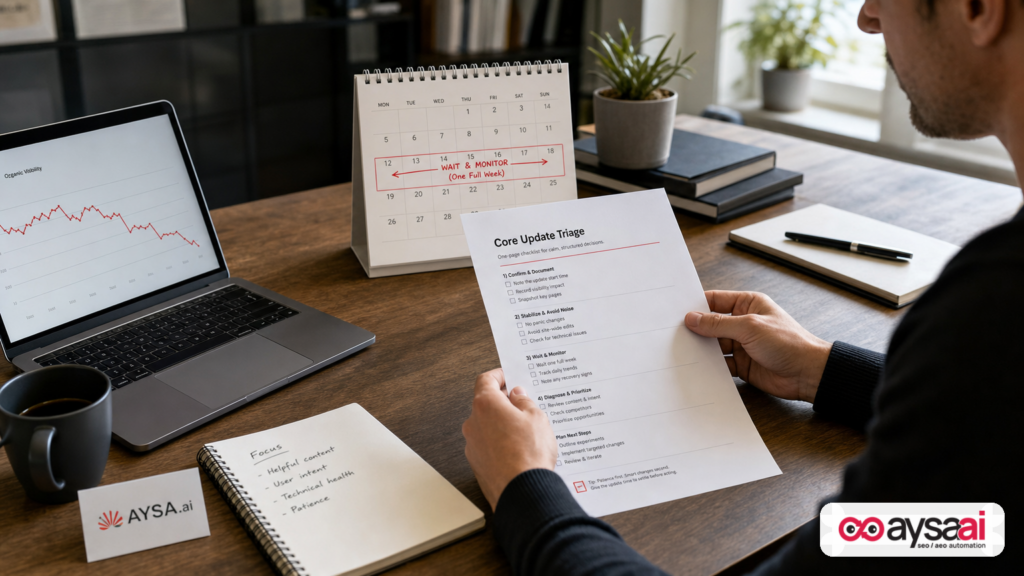
- The May 2026 core update ran ~12 days (May 21 to June 2) and produced noticeable volatility across many sites, industries, and countries, according to industry observers.
- Don’t analyze too early. Google advises waiting at least a full week after completion before evaluating Search Console data; the earliest “clean” comparison window is around June 9.
- Multi-wave volatility means multi-cause outcomes. A change you saw on May 24 may not be driven by the same underlying re-ranking logic as a change that hit June 2.
- Recovery is rarely one magic fix. The best results come from page-level diagnosis (intent, usefulness, trust signals, UX, Internal linking) paired with disciplined execution.
- AYSA.ai’s edge is operational: it helps you monitor impact, generate a prioritized plan, request approvals, and implement changes consistently—so you can move faster than competitors without “panic editing.”
Table of contents

- Key takeaways (read this before you open Search Console)
- What actually happened in May 2026 (and why it felt “heavier” than March)
- Core update basics: what Google is (and isn’t) doing
- The “multi-point movement” problem: why your May 24 drop may have nothing to do with your June 2 drop
- Why this matters to businesses (not just SEOs)
- How to measure impact the right way (the June 9 rule, segmented)
- Common failure modes after a core update (what makes things worse)
- A concrete SME scenario: an ecommerce brand that “lost rankings” but didn’t lose customers (and vice versa)
- A recovery & growth checklist (what to do in order)
- What agencies should rethink after May 2026
- Where AYSA.ai fits: monitoring + approved execution at core-update speed
- What to do next (action list)
- Sources and further reading
Key takeaways (read this before you open Search Console)
If your Organic traffic dipped or spiked during the May rollout, here’s the lens I want you to use:
1) “Update complete” does not mean “all movement was caused by one thing”
Rollouts can show volatility at multiple points. That means the update can express itself in waves across different query classes, geographies, and page types. The right question is not “Did we get hit?” It’s:
- Which page types changed (product pages, service pages, blog, location pages, category pages)?
- Which query intents changed (informational vs. transactional vs. local)?
- Which search surfaces changed (web vs. image vs. video; and how AI-driven features might influence Clicks)?
2) Wait one full week before you draw conclusions
Google’s own guidance is to wait at least one full week after the update finishes before you evaluate Search Console data, and then compare that week against the week before the rollout began. In this case, that points to roughly June 9 as the earliest clean window for analysis (based on completion on June 2).
3) Your job is not to “win back rankings.” Your job is to win back demand capture.
Businesses don’t deposit rankings in the bank. They deposit:
- Qualified leads
- Sales
- Booked appointments
- Calls
Sometimes you’ll lose a set of vanity queries and still grow revenue because the update shifts visibility toward higher-intent searches. Other times you’ll keep rankings but lose clicks because SERP layouts and AI features change what gets attention.
4) Execution speed is the new moat—if it’s controlled
The brands that recover fastest aren’t necessarily the smartest. They’re the ones who can:
- Diagnose patterns quickly
- Prioritize changes that matter
- Ship improvements without introducing new problems
This is exactly where an Approved Execution model helps: you keep human control, but you remove the bottleneck between “we know what to do” and “it’s live on the site.”
What actually happened in May 2026 (and why it felt “heavier” than March)
According to Search Engine Journal’s reporting, Google confirmed the May 2026 core update completed on June 2 after starting on May 21, lasting just under 12 days. Industry voices described it as more noticeable than March, with volatility reported across verticals and countries. This isn’t unusual for core updates—what’s unusual is when they’re not noticeable.
The practical takeaway: even if you didn’t “do anything wrong,” the competitive landscape can shift under you because Google is recalibrating how it interprets relevance and quality across the entire index.
Citation: See the SEJ coverage for the rollout timing and practitioner observations: Search Engine Journal – Google’s May Core Update Complete After Volatile Rollout.
Volatility can be a signal of re-weighting, not punishment
Many business owners hear “core update” and assume “penalty.” But a core update is better thought of as Google re-ranking the same set of candidates with a revised scoring recipe.
When the recipe changes, two things happen:
- Some sites that were previously “good enough” stop being competitive.
- Some sites that were previously overlooked become better matches.
It’s also happening in a broader environment shift toward AI-assisted search
The SEJ article notes a practitioner connecting the timing to changes announced at Google I/O, including model updates for Google’s AI search features. I’m not going to claim a direct causal relationship without primary documentation in the provided source context—but the strategic point stands: we are operating in a period where the definition of “helpfulness” includes how content can be summarized, cited, and trusted in AI-driven experiences.
If you want to build resilience, you can’t treat core updates like isolated events. You need an always-on quality and intent alignment system.
Core update basics: what Google is (and isn’t) doing
Let’s get the fundamentals clear, because most bad decisions come from misunderstanding what core updates are.
What a broad core update is (in plain English)
A broad core update is Google changing the weighting of ranking signals and/or the way it interprets relevance and quality at scale. It’s not a manual action against you. It’s not necessarily about spam. And it’s not a promise that you can “undo” it by tweaking one line of copy.
Google documents core updates and provides general guidance on how to evaluate drops and improve content. A good starting point is Google’s Search Central documentation (not included in the supplied link list, so I’m not going to pretend I pulled exact passages). If you need the official guidance, use Google Search Central’s “core updates” and “creating helpful content” resources directly.
What core updates are not
- Not a single-factor test: there is no one “core update score.”
- Not a guarantee that technical fixes alone recover you: sometimes the issue is intent mismatch or weak differentiation.
- Not only about content length: longer pages can lose; short pages can win.
Why businesses feel blindsided
Businesses optimize for what worked last quarter: a specific set of keywords, a content format, a template, a link strategy. Core updates often change the value of those choices. That’s why volatility feels personal—it invalidates “best practices” that were previously rewarded.
The “multi-point movement” problem: why your May 24 drop may have nothing to do with your June 2 drop
One of the most important insights from the SEJ reporting is this: movement happened at multiple points during rollout. That means you must treat “impact date” as a diagnostic signal.
Think in waves, not a single hit
Here’s a practical way to frame it:
- Wave A: early rollout movement—often reveals which query sets Google is recalibrating first.
- Wave B: mid-rollout turbulence—can include reversals, testing, and rebalancing.
- Wave C: late rollout settling—sometimes amplifies earlier winners/losers; sometimes corrects overreactions.
If your visibility changed only in Wave B and mostly reversed by Wave C, your “problem” might be less about content quality and more about the temporary re-ranking during system updates. That’s why Google recommends waiting a week after completion.
Single-day comparisons are a CFO’s worst enemy
Single-day snapshots are seductive because they’re easy: “We lost 18 positions on Friday.” But they’re often misleading. For business decision-making, the unit of truth should be:
- Weekly cohorts (clean week vs. baseline week)
- Segmented sets (page type + query intent + geography)
- Outcomes (leads/sales), not only impressions
Why this matters to businesses (not just SEOs)
Core updates matter because they change the cost structure of growth.
1) Organic is often your highest-margin channel
Paid media is a lever. Organic is (ideally) an asset. When a core update reshuffles visibility, it can shift your unit economics—especially if you rely on organic to keep CAC under control.
2) It changes what customers see as “credible”
Search results are a trust distribution system. If Google starts surfacing different brands, different formats, or different kinds of pages, that changes the default shortlist customers consider.
3) It can expose operational fragility
Most companies don’t fail SEO because they lack ideas. They fail because execution is brittle:
- Teams can’t ship changes quickly.
- Developers are backlogged.
- Content updates take weeks of approvals.
- Analytics aren’t clean enough to diagnose.
Core updates punish fragile operations. Not intentionally—mechanically.
How to measure impact the right way (the June 9 rule, segmented)
SEJ notes Google’s guidance: wait at least a full week after completion, then compare that week to the week before the rollout began. With a June 2 completion, that suggests around June 9 as the earliest clean comparison window.
Here is the measurement approach I recommend for SMEs and lean teams.
Step 1: Set your comparison periods
- Baseline week: the 7 days immediately before May 21 (the reported start date).
- Clean week: the 7 days starting around June 9 (one week after completion).
If you have enough data volume, also evaluate a second clean week to reduce noise.
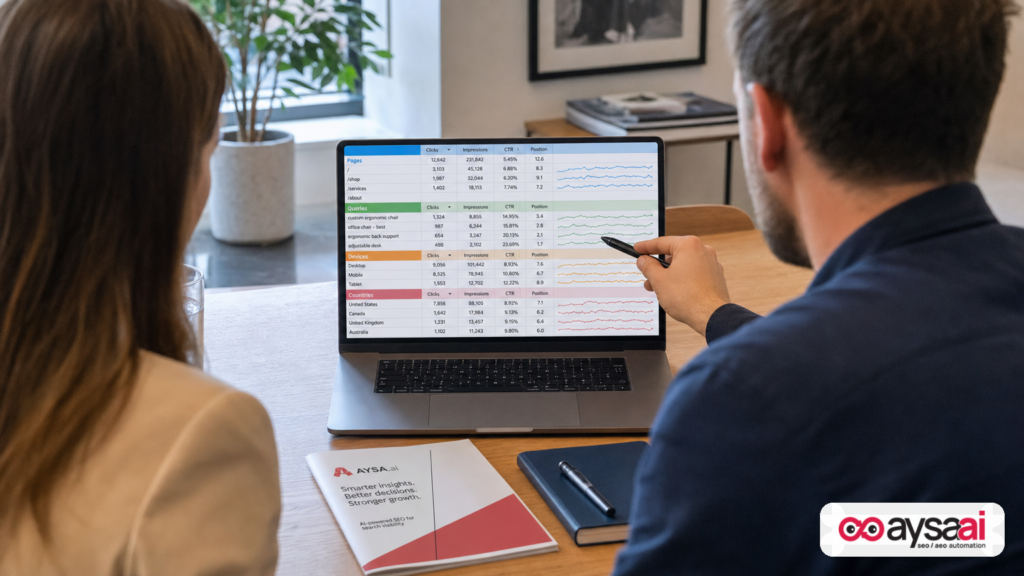
Step 2: Use Search Console like an analyst, not like a headline reader
Google Search Console (GSC) is not just “positions.” It’s your best native dataset for:
- Which queries lost impressions vs. lost clicks (SERP feature changes can reduce clicks even if rank holds)
- Which pages shifted (page-type diagnosis)
- Which countries and devices changed (market-specific impact)
If your team needs help building a monitoring habit around these segments, that’s exactly the purpose of an execution platform paired with monitoring. See how AYSA approaches this at AYSA Monitoring.
Step 3: Segment by page type (this is where most teams skip)
Create buckets like:
- Commercial: category pages / service pages
- Transactional: product pages / booking pages
- Informational: blog articles / guides
- Trust: about, reviews, policies, shipping, returns
- Local: location pages (if applicable)
Core updates often create a clear pattern: “informational content got crushed, money pages held,” or “category pages improved, blog declined,” etc. Once you see the pattern, the fix becomes obvious (and it’s rarely “rewrite everything”).
Step 4: Connect to business outcomes
If you’re not tying organic shifts to leads/sales, you’ll either panic unnecessarily or miss a real revenue leak. In GA4 (or your CRM), check:
- Organic conversion rate changes
- Landing page conversion changes
- Lead quality shifts (if tracked)
Even if we can’t cite GA4 documentation from the supplied research context, the principle is universal: rank is an input; revenue is the output.
Common failure modes after a core update (what makes things worse)
I’ve seen the same post-update mistakes repeatedly. Here are the ones that cost the most money.
Failure mode 1: “We must change everything”
Teams rewrite pages wholesale, change titles across the site, restructure navigation, and push new templates—while they still don’t understand what moved. This is how you turn a ranking issue into a conversion issue.
Failure mode 2: “We must change nothing”
The opposite mistake is paralysis. If your competitors are improving clarity, differentiation, and internal linking while you wait three months, the update becomes a permanent step-down in visibility.
Failure mode 3: Chasing third-party volatility charts as if they’re your analytics
Volatility tools can be helpful as a weather report. But they aren’t your business. Your business is in GSC and your conversion tracking.
Failure mode 4: Over-indexing on “EEAT theater”
Yes, credibility signals matter—especially for sensitive topics. But adding an author box and a few badges is not a strategy if the page doesn’t satisfy intent better than alternatives.
Failure mode 5: Letting execution bottlenecks kill momentum
You finally identify what needs improvement—and then it sits in a ticketing system for six weeks. In core update seasons, that lag is strategic risk.
This is why I’m bullish on systems that combine monitoring with controlled execution. Learn more about AYSA’s approach to AI-assisted SEO workstreams here: AYSA AI SEO Tools.
A concrete SME scenario: an ecommerce brand that “lost rankings” but didn’t lose customers (and vice versa)
Let’s make this real with a scenario I see all the time.
The business
A mid-sized ecommerce brand selling specialty home goods. Strong category pages, lots of blog content for top-of-funnel queries, and seasonal demand spikes.
What they see during the May rollout
- Blog traffic drops sharply over a weekend.
- Category pages remain stable or slightly improve.
- Overall sessions decline, but revenue holds steady.
What’s actually happening (one plausible explanation)
Core updates can change how Google values certain informational content formats (especially if they’re redundant, templated, or not clearly differentiated). If the blog content loses visibility but the category pages gain, the brand may lose top-of-funnel visitors but keep high-intent shoppers—so revenue doesn’t drop.
Now flip it:
- Traffic holds steady.
- Revenue drops.
In that case, the update might be altering which queries you win—shifting you toward lower-intent traffic—or changing SERP layouts such that you’re getting clicks that don’t convert.
The lesson for SMEs
You don’t “fix SEO” by restoring a traffic number. You fix it by restoring (or improving):
- Visibility on the queries that drive profitable actions
- Landing pages that close those actions
How AYSA helps in this scenario
This is where a system that combines monitoring + prioritized recommendations + approved execution is practical. Your team can:
- Monitor page groups and intent clusters (Monitoring)
- Generate a backlog of fixes (titles, internal linking, content refresh, technical hygiene)
- Approve what’s safe and aligned with brand voice
- Execute changes reliably—without a rewrite frenzy
A recovery & growth checklist (what to do in order)
This checklist is designed to be usable by a non-SEO founder, a generalist marketer, or a lean agency team. The goal is to make decisions that are both data-driven and operationally feasible.
Phase 1: Stabilize (during rollout and the first week after)
- Freeze major structural changes unless you have a clear technical emergency (e.g., indexing, robots, canonical disasters).
- Document the timeline: note when you saw changes and on what page types.
- Verify tracking health: ensure analytics and conversions are firing correctly (don’t confuse tracking failures with algorithm impact).
- Protect the money pages: confirm your core commercial pages are indexable, fast enough, and not suffering from obvious UX regressions.
Phase 2: Diagnose (starting with the clean comparison window)
- Run the clean week vs. baseline week comparison in GSC.
- Identify the top losing and winning pages by clicks and impressions (not just position).
- Cluster by intent: are the losses mostly informational? local? product comparisons? “best X” lists? “near me” terms?
- Check whether it’s a click problem or an impression problem:
- Impressions down = you’re being shown less (relevance/eligibility issue)
- Clicks down but impressions stable = SERP layout/CTR issue (title/snippet/value proposition)
Phase 3: Fix (prioritize changes that compound)
Here’s the priority stack I typically recommend, because it tends to deliver the best return with the least collateral damage:
- Intent alignment and page purpose clarity
- Make the page’s job obvious in the first screen.
- Remove or demote content that distracts from the primary intent.
- Add missing “decision info” (pricing ranges, availability, process, constraints) where appropriate.
- Differentiation (why you, not “a page about the topic”)
- Add original elements: step-by-step process, checklists, photos you own, comparison tables you can stand behind (no invented stats).
- Strengthen trust content: policies, credentials, service coverage, contact clarity.
- Internal linking and information architecture
- Ensure supportive content points to your commercial pages.
- Build topic clusters that help Google understand your site’s focus.
- Technical hygiene
- Indexation sanity: canonicals, parameter handling, thin duplicates.
- Performance: avoid heavy scripts that degrade UX.
- Structured data where appropriate (only if accurate and compliant).
Phase 4: Prove (measure and iterate)
- Measure in two-week blocks to reduce noise.
- Track by page group, not by one “hero keyword.”
- Keep a change log so you can attribute improvements (or declines) to actual actions.
This is also where AI search visibility becomes relevant: many teams are now optimizing not only for rankings but for being referenced and cited in AI-driven experiences. AYSA’s perspective and tooling on this is here: AI Search Visibility.
What agencies should rethink after May 2026
If you run an agency, May 2026 is another reminder that the traditional SEO retainer model is under pressure—not because SEO is less valuable, but because operational expectations are changing.
1) Clients don’t want “reports.” They want “recovery velocity.”
In update cycles, clients care about time-to-diagnosis and time-to-implementation. Reporting is only useful if it leads to action.
2) Strategy without execution is a liability
Agencies often deliver recommendations that require developer time, content team time, approvals, and coordination. The more steps, the slower the impact. In volatile environments, slow execution is effectively a competitive disadvantage you’re selling to your clients.
3) The new agency deliverable is a controlled change engine
Agencies that win will look more like:
- Monitoring + diagnosis + prioritized backlog
- Fast, safe implementation cycles
- Approval workflows that keep clients comfortable
- Continuous improvements rather than “big bang” audits
AYSA is built around that operational reality: prepare changes, ask for approval, and execute what’s accepted—so agencies can scale outcomes without scaling chaos. If you want to explore how this fits your workflow, start here: AYSA Pricing and browse more tactical editorials at AYSA Blog.
Where AYSA.ai fits: monitoring + approved execution at core-update speed
Let me be direct: core updates are not just SEO events. They are operational stress tests.
The teams who navigate them best usually have three capabilities:
- Visibility: they detect what changed, where, and when.
- Judgment: they prioritize fixes with the highest impact and lowest risk.
- Execution: they ship improvements consistently, with quality control.
AYSA.ai is designed to be the execution layer that many SMEs and agencies are missing:
1) Monitor what matters (not just rank)
Monitoring should help you answer business questions: which pages and intents are gaining/losing, and how that maps to leads/sales. See: AYSA Monitoring.
2) Prepare changes like a responsible operator
AI can draft improvements and identify gaps, but businesses need control. AYSA prepares proposed website changes (content, technical, on-page structure) in a way that can be reviewed.
3) Ask for approval (so you don’t get “AI drift”)
The fastest way to break brand trust is uncontrolled automation. AYSA’s model is to request approval before implementing changes—especially important during update volatility.
4) Execute accepted changes (so your plan becomes reality)
Many SEO tools stop at “recommendations.” AYSA is built to help you implement—closing the loop between diagnosis and outcomes. Start with: AI SEO Tools.
What to do next (action list)
If you want a simple plan you can actually follow, here it is:
- Mark your calendar for the clean window (about a week after June 2; SEJ points to ~June 9).
- Create a one-page change log: what you changed on the site during May 21–June 9 (content, dev releases, design changes, migrations).
- In Search Console, compare clean week vs. baseline week and export top losing/winning pages.
- Bucket losses by page type and intent (blog vs. product vs. service vs. location).
- Pick 5–10 pages that matter to revenue and perform an intent/differentiation review.
- If impressions dropped: improve relevance and comprehensiveness for that intent.
- If clicks dropped but impressions didn’t: improve titles/snippets and on-page value proposition.
- Ship improvements in controlled batches (not a sitewide rewrite).
- Set up ongoing monitoring so you catch trend changes early: AYSA Monitoring.
- If execution is your bottleneck, evaluate an approved-execution workflow: AI Search Visibility and Pricing.
Sources and further reading
- Search Engine Journal: Google’s May Core Update Complete After Volatile Rollout (rollout timing, volatility observations, guidance to wait a week)
- Search Engine Journal: Google Algorithm Updates history hub (context for past updates)
- Search Engine Journal: SEO News (ongoing update coverage)
Related AYSA resources:
Continue the AI search topic inside AYSA.
Use these pages to connect the article with AI SEO tools, AI visibility monitoring, AI Overviews and approved website execution.
Turn this topic into a website action plan.
Use these AYSA hubs to move from reading to technical fixes, AI visibility monitoring, research, glossary context and approval-first SEO execution.

