
SEO + GEO Audit Essentials: How to Audit for Search, AI Answers and Real Execution
A modern SEO and GEO audit should not stop at scores and screenshots. It should check crawlability, content usefulness, entity clarity, AI visibility, answer quality and what can be executed safely after approval.
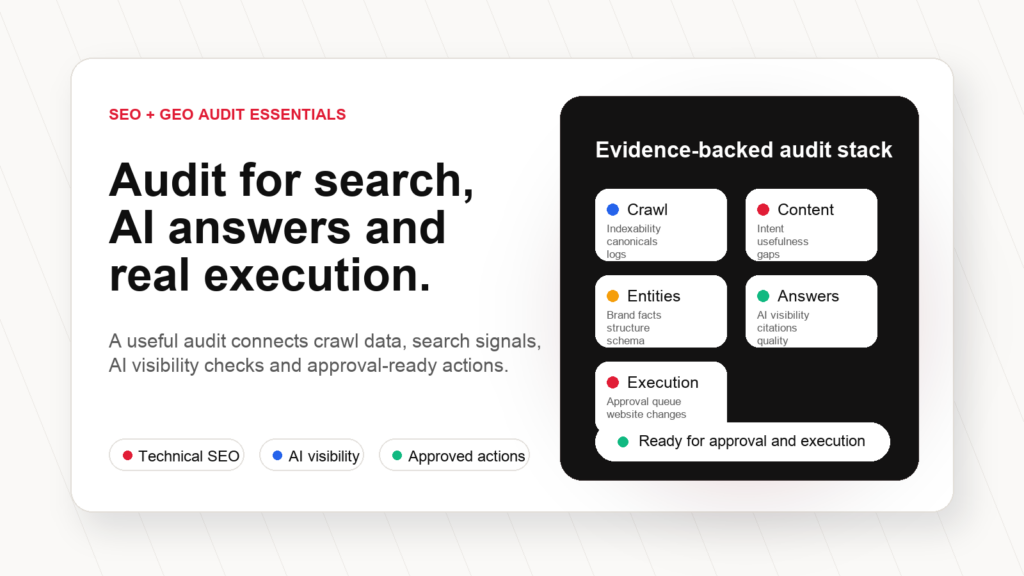
Summary: SEO audits and GEO audits are starting to merge. A useful audit now has to inspect whether a website can be crawled, indexed, understood, cited, summarized and improved. That means Technical SEO, content quality, Entity Clarity, AI answer visibility, Structured data, Internal linking and execution workflow need to be reviewed together.
The most important shift is this: an audit is not valuable because it produces a long list of issues. It is valuable when it turns evidence into prioritized, approval-ready actions that can actually be implemented. For SMEs and non-SEO teams, that is the difference between another report and a search operating system.
Why SEO and GEO audits are now the same conversation
For years, an SEO audit usually meant a crawl, a list of technical issues, metadata checks, indexation diagnostics, speed recommendations, content gaps and Backlink observations. That work still matters. Google has not stopped Crawling, indexing and ranking web pages. Search engines still need accessible URLs, useful content, clear page structure, consistent canonicals, internal links, sitemaps, performance and trust signals.
What changed is the surface where discovery happens. Users are no longer only clicking through ten blue links. They are reading Google AI Overviews, testing AI Mode, asking ChatGPT, comparing answers in Perplexity, using Gemini, and expecting direct explanations before they visit a website. This is where generative engine optimization, or GEO, enters the picture.
A GEO audit asks a different but connected question: can AI-assisted systems understand the business, retrieve the right pages, summarize the brand accurately and connect the user’s question to the right answer? That question depends on classic SEO foundations. If important pages are blocked, thin, slow, duplicated, unclear or poorly linked, AI systems have less reliable material to work with.
So the modern audit should not split SEO and GEO into two separate universes. A good audit should connect technical search readiness with AI answer readiness. It should ask: can crawlers reach the page, can search engines index it, can users understand it, can AI systems extract it, and can the business approve and execute the necessary improvements?
The common mistake: asking AI for an audit without evidence
AI can help with audits, but only when it is grounded in evidence. A weak AI audit starts with a generic prompt: “Audit my website for GEO.” The model then produces plausible recommendations based on broad SEO knowledge. Some suggestions may be reasonable. Others may be generic, irrelevant or impossible to prioritize.
A stronger audit gives the model real inputs: crawl exports, Search Console queries and pages, analytics patterns, page templates, screenshots, structured data output, robots and sitemap rules, important business entities, competitor examples and known conversion priorities. The more evidence the audit has, the less it relies on guesswork.
This is why the Search Engine Land discussion is useful: a GEO audit needs context, methodology and human review. Context means the audit understands the website, market, brand, business model and audience. Methodology means it does not randomly ask a model for opinions, but follows a repeatable process. Human review means important conclusions are checked before changes are made.
For AYSA, the human-in-the-loop part is not just proofreading. It is approval control. The agent can prepare the work, explain why it matters and propose what should change, but meaningful publishing and authority actions should remain controlled by the business. That is how automation stays useful without becoming blind autopilot.
Weak AI audit
- Generic prompt
- No crawl data
- No search performance context
- No business priorities
- Advice stays theoretical
Evidence-backed audit
- Website crawl and index data
- Search Console and analytics signals
- Entity and content checks
- AI answer visibility tests
- Approval-ready actions
The SEO + GEO audit stack
A practical audit should be layered. Each layer answers a different question, and each question should lead to an action that can be approved or rejected.
1. Crawlability and indexability
The audit starts with access. Are important URLs crawlable? Are they blocked by robots.txt, noindex, canonical mistakes, redirects, JavaScript rendering problems or broken internal links? Are sitemap URLs canonical, indexable and returning status 200? Are there parameter traps, faceted URLs or thin archives wasting crawl budget?
This layer matters for GEO because AI-assisted search still depends on retrievable documents. If a page is not accessible, not indexable or hidden behind poor rendering, it is less likely to support discovery in classic or AI-assisted search.
2. Technical SEO and performance
Technical checks should include Core Web Vitals, mobile usability, page speed, response codes, redirect chains, canonical consistency, structured data validity, sitemap hygiene and template-level problems. Performance is not only a user experience issue. It affects crawling, rendering and how reliably systems can process the page.
3. Content usefulness and intent coverage
A page should not only mention a keyword. It should satisfy a real user at a real stage of the journey. A service page should explain what the service is, who it is for, location, process, pricing or pricing logic, trust signals, examples, FAQs and next steps. A product page should explain specifications, use cases, compatibility, delivery, returns and comparison criteria. Thin content is weak for search and weak for answer engines.
4. Entity and brand clarity
AI systems need to understand what the business is, what it sells, where it operates, who it serves and why it should be trusted. The audit should inspect brand consistency, organization details, author details, product and service naming, local entities, industry terms and the relationship between pages. Entity clarity is not magic. It is the result of consistent, visible, well-structured information.
5. Structured data that matches visible content
Structured data can help search systems understand page content, but it is not a replacement for visible usefulness. The audit should validate schema output and check whether it matches what users can actually see. Fake or unsupported markup is a risk. Good structured data reinforces clear page content.
6. Internal linking and topical authority
An audit should identify orphan pages, weak hub pages, missing cluster links and important pages that are too deep in the site architecture. Internal links tell users and machines which pages belong together. For AI search, strong topical structure makes it easier to retrieve related, coherent evidence.
7. Authority and citation signals
Authority building should be reviewed carefully. The audit should inspect existing mentions, backlinks, publisher opportunities, local citations and brand references. The goal is not risky link buying. The goal is to understand whether the business is referenced by relevant, trustworthy sources and whether authority work should be proposed for approval.
How to audit AI answer visibility without fooling yourself
AI answer visibility is not the same as ranking position. The same brand can appear in one answer, disappear in another and be mentioned without a link in a third. Prompts, model versions, location, freshness and query wording can all change outputs.
A useful audit should therefore avoid overconfidence. It should test a defined set of business-critical questions, record the answer, note whether the brand is mentioned, check whether it is cited, identify which sources are used, and compare the answer against the website’s own content. The goal is not to declare a perfect visibility score from a few prompts. The goal is to find patterns that can guide action.
For example, a medical clinic might test questions about pediatric services, emergency versus appointment care, pricing, parking, insurance, doctors and online booking. An ecommerce store might test product comparisons, delivery questions, returns, category recommendations and “best option for” queries. A local service business might test city modifiers, review criteria, availability and trust questions.
The audit should then ask: if AI systems do not mention the business, is the problem weak authority, unclear content, missing service pages, poor local signals, thin FAQs, lack of third-party references or technical accessibility? This is where GEO becomes practical. The answer should point to specific improvements, not vague “optimize for AI” advice.
The missing layer: from audit findings to approved execution
Most audits fail after diagnosis. They identify issues, estimate impact, maybe assign priorities, and then leave the business with work to do. That is already hard for SEO teams. It is much harder for SMEs, ecommerce operators, clinics, local businesses and non-specialists.
A modern audit should end with an execution backlog. Each recommendation should include the affected page or template, why it matters, what should change, expected risk, approval requirement and whether the action can be automated safely. The output should be understandable to a business owner, not only an SEO specialist.
There is a big difference between “your content lacks entity clarity” and “add a clear services section to the pediatric clinic page that lists ages served, appointment options, emergency guidance, doctor credentials, parking details and booking next steps.” The second recommendation is useful because it can be reviewed and implemented.
This is also where approval matters. Technical changes, content rewrites, schema updates, internal links, redirects and authority opportunities should not all be treated the same. Some can be low-risk. Some need human review. Some require legal, medical, brand or business approval. A strong audit respects that difference.
What SMEs should do first
If you run a smaller business, do not start with a giant GEO report. Start with the pages that already matter: homepage, service pages, product categories, money pages, local pages, high-impression pages and pages that should convert but do not. Then audit them through a simple lens:
- Can search engines and AI crawlers access the page?
- Does the page answer the user’s real question better than competitors?
- Is the business entity clear: who, what, where, for whom and why trust it?
- Are important facts visible and consistent?
- Are related pages linked together?
- Does the page include concrete next steps?
- Can the improvements be approved and published without manual chaos?
This approach is less glamorous than a 90-page deck, but it is more likely to produce results. Search visibility improves when useful pages become clearer, stronger, faster and easier to retrieve. AI visibility improves when the same facts become easier to extract, cite and summarize.
Where AYSA fits: audit intelligence plus approved execution
AYSA is built around a simple operating belief: SEO, AEO and GEO should move from research to approved action. The agent can monitor your website, understand your business context, identify search and AI visibility gaps, prepare work, ask for approval and execute accepted changes inside the website workflow.
That matters because a GEO audit without execution creates more work for the user. AYSA is designed for businesses that do not want to live inside SEO dashboards or copy-paste recommendations between tools, documents and WordPress. The point is not to remove human control. The point is to remove unnecessary manual SEO labor while keeping approval where it belongs.
In my opinion, the next generation of SEO platforms will be judged less by how many issues they can detect and more by how well they can turn evidence into safe, prioritized, approved website improvements. That is the bridge between traditional SEO audits and real GEO readiness.
A practical SEO + GEO audit checklist
- Validate crawlability, indexability, canonicals, robots and sitemap status.
- Check technical performance, response codes, redirects, structured data and mobile rendering.
- Review page usefulness against real search intent and buyer questions.
- Map entity signals: brand, locations, products, services, authors and trust information.
- Test AI answer visibility for business-critical questions, but treat outputs as signals, not absolute truth.
- Identify missing pages, weak FAQs, unclear service details and unsupported claims.
- Review internal links and topic clusters for retrieval-friendly structure.
- Turn findings into approval-ready actions with owner, risk and execution path.
Sources and further reading
Less SEO work. More organic growth.
Turn SEO and GEO audits into approved website action.
AYSA monitors your website, prepares SEO, AEO and AI visibility work, asks for approval and executes accepted changes inside your website workflow.
Continue the AI search topic inside AYSA.
Use these pages to connect the article with AI SEO tools, AI visibility monitoring, AI Overviews and approved website execution.
Turn this topic into a website action plan.
Use these AYSA hubs to move from reading to technical fixes, AI visibility monitoring, research, glossary context and approval-first SEO execution.

