The YouTube-to-AI Overviews Gap: Why Views Don’t Equal Search Visibility (And What SMEs Should Do Now)
YouTube is showing up as a primary citation inside Google’s AI answers, but most teams still measure video like it’s 2012: by views. In 2026, the real ROI of creator partnerships shows up downstream—in AI citations, referral traffic, assisted conversions, and brand preference. Here’s how to build a practical, measurable YouTube partnership engine that supports SEO/AEO/GEO, with an execution plan SMEs can actually run.

For 20 years, many teams treated YouTube as a “nice-to-have” channel: something for brand awareness, a place to repost TV ads, or a sandbox for the occasional product demo.
That framing is now expensive.
In 2026, YouTube is increasingly part of the search layer—because the search experience is being rebuilt around AI answers, and those answers need sources they can summarize, cite, and trust. If you’re only measuring creator partnerships by view counts, you’re likely undercounting (or miscounting) the impact where it matters most: AI citations, Referral traffic, assisted conversions, and revenue.
This editorial is my practical take—written for founders, marketers, and agency operators who want a plan that works without turning their business into a media company. I’ll outline what changed, why it matters, what can go wrong, how to measure the downstream effects, and how AYSA fits as an execution system that turns strategy into approved on-site changes.
Concise summary
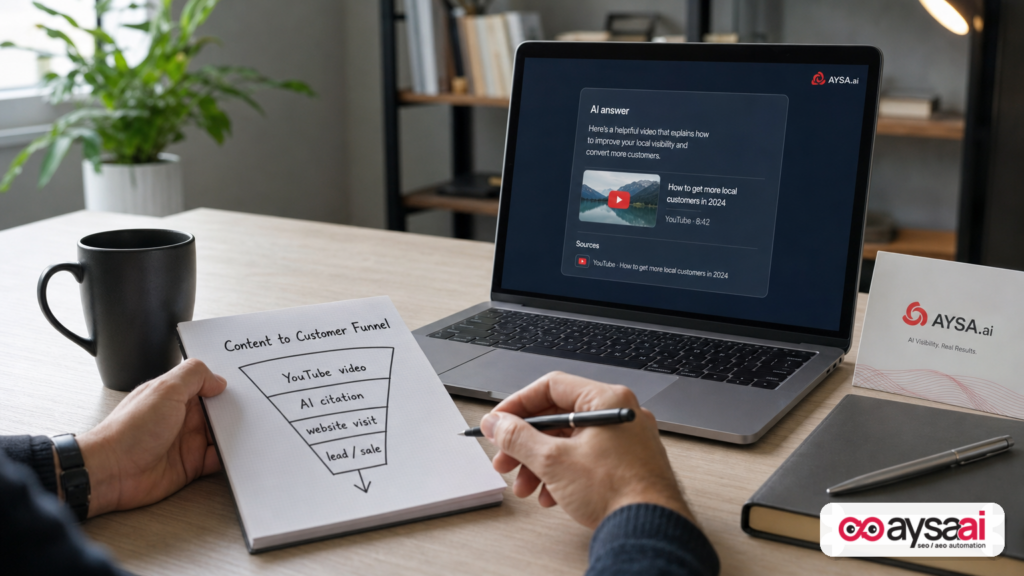
- YouTube is becoming a first-class input to AI-powered search answers, including Google’s AI Overviews, which cite sources directly.
- View counts are an incomplete KPI. The value of creator partnerships often appears downstream: referrals, brand searches, AI citations, and conversions.
- Most teams have a “YouTube gap”: no creator relationships, no production workflow, and no measurement model connected to SEO/AEO/GEO.
- The fastest path is partnerships, not a “start from zero” in-house channel—especially for SMEs.
- Execution is where ROI is won: landing pages, internal links, Entity Clarity, and measurement plumbing. AYSA helps by monitoring, preparing changes, asking for approval, and executing accepted updates.
Key takeaways (the business version)
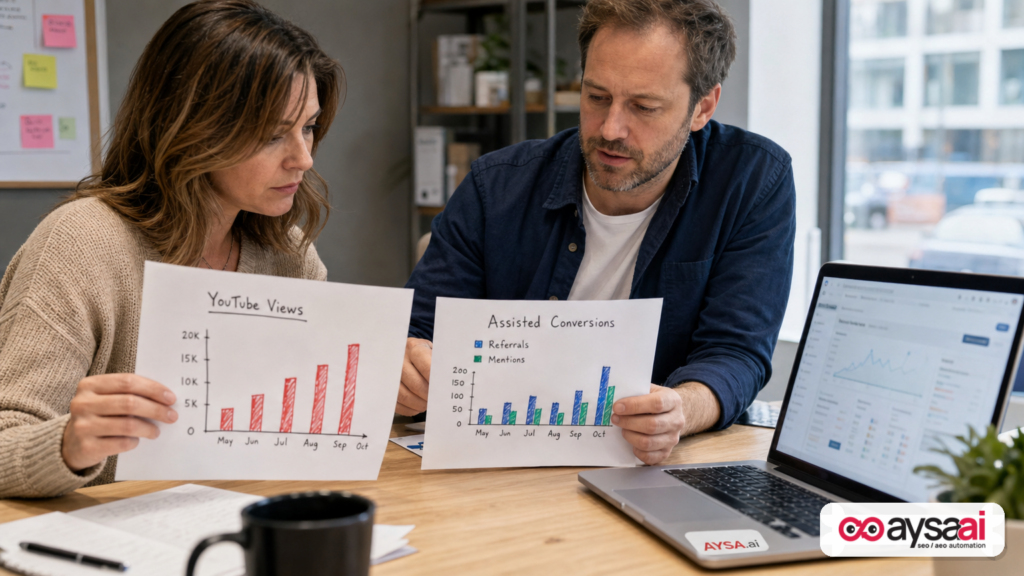
- If your YouTube KPI dashboard ends at views, you’re flying blind. You need a measurement model that includes referral traffic, assisted conversions, and “mention/citation” signals in AI search.
- Creator partnerships are now part of your search visibility strategy. Not because “video is hot,” but because AI answer engines are selecting sources, and video is frequently among them.
- Don’t build a YouTube strategy in a silo. Build a partnership-and-execution system that ties videos to pages, categories, FAQs, product education, and local trust signals.
Table of contents

- What Changed: YouTube Is Becoming a First-Class Source for AI Answers
- Why the Gap Matters More Now Than It Did 10–20 Years Ago
- The Metrics Problem: Why View Counts Understate (or Misstate) Business Value
- How AI Answers Pick Sources (and Where Video Fits)
- The Fix Isn’t “Start a Channel.” It’s Build Partnerships as Search Infrastructure
- How to Select Creators for Search Outcomes (Not Just Reach)
- Your Website Still Matters: Landing Pages, Entities, and Conversion Paths
- Measurement That Finance Will Respect: A Practical KPI Stack
- What Can Go Wrong: Risks, Misalignment, and “AI Slop” Spillover
- SME Scenario: A Local Clinic Competing Against Aggregators in AI Search
- What Agencies Should Rethink (and What In-House Teams Should Demand)
- Where AYSA Fits: Monitoring + Approved Execution for AEO/GEO Readiness
- A 30–90 Day Action Plan
- What to do next
- Sources and further reading
What Changed: YouTube Is Becoming a First-Class Source for AI Answers
The core shift is simple: search is no longer just a list of links. It’s increasingly an answer layer—and those answers cite sources. In the source article from Search Engine Journal, Greg Jarboe highlights an important emerging pattern: YouTube videos are surfacing inside AI Overviews with increasing frequency, sometimes as a primary cited reference rather than a supplementary link.
That’s not a “video marketing trend.” That’s a distribution change.
When the UI shifts from “ten blue links” to “one synthesized answer + a handful of citations,” the winners are not merely the sites with the most content. The winners are the sources that the system chooses to cite and summarize.
If you spent the last decade building text-first SEO—blogs, category pages, link building—good. But if you ignored YouTube as a serious source format, you may now have a blind spot: the source type that AI answers are willing to cite for certain queries (how-to, comparisons, demonstrations, troubleshooting, and anything where “seeing it” resolves ambiguity).
Important constraint: we should be careful not to claim universal behavior across every industry or query. Google’s AI answer experiences evolve. But the directional signal is clear enough to demand action: video sources, especially on YouTube, are increasingly intertwined with AI-powered search experiences.
Primary research lead: Search Engine Journal – “The AI Overviews YouTube Gap: The Platform Your Team Skipped For 20 Years”.
Why the Gap Matters More Now Than It Did 10–20 Years Ago
In 2006–2016, ignoring YouTube usually cost you two things:
- Incremental awareness
- Some missed social reach
In 2026, ignoring YouTube (and creators) can cost you something more fundamental: inclusion in the citation set that AI answers pull from. That’s closer to “share of shelf” than “extra impressions.”
Jarboe’s argument is that many SEO and content teams treated YouTube like a side channel for too long. He frames the “gap” as not just a content gap, but an organizational one: no creator partnerships, no muscle memory, no workflow integration between influencer budgets and SEO outcomes.
His other key point is also the one most businesses still resist: the value of a video often shows up off-platform. If you measure video like a TV spot (impressions) or like a social post (views), you’ll miss the business impact (traffic, citations, conversions).
He also cites YouTube’s own claims about economic impact and small business growth tied to having a channel. The original source references YouTube CEO Neal Mohan’s sharing of YouTube’s U.S. impact report and an accompanying YouTube blog post. Those are useful context signals, but for most SMEs the more actionable takeaway is: there is already a large creator workforce, across geographies and niches—meaning you can partner faster than you can build from scratch.
The Metrics Problem: Why View Counts Understate (or Misstate) Business Value
Views are not useless. They’re just not a business outcome.
Here are the three reasons view counts mislead teams in an AI-search world:
1) Views don’t represent purchase intent
A viral video can produce millions of low-intent views. A niche video with a few thousand views can produce a disproportionate number of qualified visitors and buyers—especially in B2B, local services, or high-consideration ecommerce categories.
2) Views don’t represent distribution
Creators distribute on more than YouTube: email lists, community posts, Shorts, podcasts, other social platforms, and—most importantly—they influence what other people create and link to. That’s the downstream effect Jarboe described with an early YouTube video that didn’t “win on YouTube,” but helped trigger broader coverage and traffic elsewhere (as described in the SEJ source).
3) Views don’t represent AI visibility
In classic SEO, a ranking might correlate with traffic. In AI answers, a citation might correlate with traffic—or it might correlate with something else: brand recognition, trust, assisted conversions, and increased direct searches later.
If your only measurement is “did it get views,” you are not measuring the primary role video increasingly plays: earning inclusion in the answer layer.
How AI Answers Pick Sources (and Where Video Fits)
We should avoid pretending we can see inside every AI ranking model. But we can still reason about what’s happening based on observable behavior and common sense.
AI answer engines (including Google’s AI experiences) appear to prefer sources that are:
- Relevant to the question, including implied intent (how-to vs. best vs. price vs. symptoms vs. comparison).
- Understandable—clear structure, clear claims, clear scope.
- Trustable—signals of expertise, accuracy, and consistency.
- Demonstrative when ambiguity is high (showing how something works is more reliable than describing it).
Video is inherently demonstrative. That’s why it shows up so often for:
- Installation and troubleshooting (“how do I fix…”)
- Product comparisons (“which is better…”)
- Technique-based tasks (recipes, workouts, repairs)
- Local services where trust is visual (clinics, contractors, salons)
But there’s a catch: your business still needs a website that can capture and convert the demand video creates. AI answers may cite a video, but the purchase path often ends on a site—your site, a marketplace, or a competitor’s.
The Fix Isn’t “Start a Channel.” It’s Build Partnerships as Search Infrastructure
Here’s the uncomfortable truth: starting a YouTube channel from scratch in 2026 can be slow, expensive, and psychologically draining—especially for SMEs that don’t have media talent in-house.
The SEJ source argues the better first move for many brands is to work through creator partnerships: find creators who already have credibility with your audience, and integrate those partnerships into your SEO/content workflows rather than treating them as a separate budget line with separate goals.
I agree—with a key condition: partnerships must be operationalized. Otherwise you’ll do a few sponsorships, get some views, and conclude “YouTube doesn’t work for us.”
Think of creator partnerships as infrastructure, not campaigns:
- Repeatable briefs tied to search intents (comparison, setup, mistakes to avoid, troubleshooting, buyer guides).
- Distribution agreements (where else will it be shared, what formats, what timeline).
- On-site conversion assets (landing pages, product bundles, local appointment pages, email captures).
- Measurement plumbing (UTMs, offer codes, referral tracking, assisted conversion reporting).
- Repurposing pipeline (clips, transcripts, FAQs, support articles, category copy).
When you run it this way, the partnership becomes a compounding asset: it can earn citations, links, brand searches, and conversions long after the upload date.
How to Select Creators for Search Outcomes (Not Just Reach)
Most teams choose creators the way they choose billboards: “How many people drive by?” That’s reach-first thinking.
If your goal is AI search visibility and qualified demand, the criteria change.
1) Niche authority beats broad reach
The SEJ source explicitly recommends finding creators who are relevant and influential in your category—not necessarily the biggest names. That’s right. A mid-sized channel that is trusted inside a niche often outperforms a broad lifestyle channel when a purchase decision is on the line.
2) Match the creator to the query format
Different creators win different query types:
- Reviewer creators win “best X” and “X vs Y” queries.
- How-to educators win setup, troubleshooting, and mistakes-to-avoid queries.
- Practitioner creators (clinicians, mechanics, stylists) win “should I worry about…” and “what does it mean when…” queries—because they convey expertise and caution.
3) Trust signals beat production polish
High production can help retention, but it doesn’t automatically create trust. Trust comes from consistency, specificity, and a track record of being right. In many verticals, slightly imperfect but honest content outperforms “brand perfect.”
4) Commercial clarity is non-negotiable
You need clear agreements about:
- What claims can be made (especially in regulated industries)
- What can be shown (product usage, before/after, pricing)
- What the CTA is (site landing page, demo request, appointment booking)
This isn’t about controlling the creator’s voice. It’s about ensuring the partnership produces usable business outcomes and doesn’t create compliance risk.
Your Website Still Matters: Landing Pages, Entities, and Conversion Paths
If you get cited in AI answers or drive qualified traffic from YouTube, your website must be able to:
- Confirm relevance fast (the visitor must immediately see “I’m in the right place”).
- Answer objections (shipping, returns, warranty, safety, qualifications, availability).
- Convert without friction (checkout, booking, demo request, phone call).
Here’s where many SMEs lose the game: they invest in content or partnerships, but they don’t update the site. They send traffic to a generic homepage or a product page with thin context, and conversions disappoint.
To make creator partnerships work for AI search and revenue, build a small set of “video-ready” landing assets:
1) Dedicated landing pages (not just the homepage)
- One landing page per partnership theme (e.g., “Beginner’s Guide,” “Comparison,” “How to choose”).
- Short, clear summary above the fold.
- FAQ section reflecting real questions asked in the video comments.
- Strong CTA with a single next step.
2) Internal linking that connects education to money
Educational pages should link to:
- Product/category pages
- Appointment booking pages
- Pricing pages
- Lead magnets
This is basic, but it’s shockingly often missing—especially on sites that were built for aesthetics rather than demand capture.
3) Entity and topical clarity
AI systems need to understand who you are and what you do. That’s not only “schema,” but it can include structured signals, consistent naming, and clear topical focus across your site and content.
AYSA’s role here is practical: monitor what’s happening, prepare the improvements, and—only after approval—execute the updates across the site in a consistent way.
Relevant AYSA resources:
- AI search visibility overview
- AI SEO tools (AEO/GEO-ready workflow)
- Monitoring (so you’re not guessing)
Measurement That Finance Will Respect: A Practical KPI Stack
If you want creator partnerships to survive budget season, you need a measurement system that matches how outcomes actually happen.
Start with a layered KPI stack:
Tier 1: Revenue and leads (the only KPIs that truly “count”)
- Direct conversions from creator traffic (tracked via landing pages, UTMs, and/or offer codes)
- Qualified leads (demo requests, quote forms, calls)
- Booked appointments (local services)
Tier 2: Assisted conversions (the reality of modern buying)
- Assisted conversions where YouTube/creator traffic was part of the path
- Time-lagged conversion uplift after a creator campaign
- Branded search lift (more people searching your brand/product names)
Tier 3: Visibility signals (leading indicators)
- Referral traffic from YouTube descriptions, pinned comments, creator sites, and social posts
- Backlinks or press mentions triggered by the collaboration (when applicable)
- Evidence of citations/mentions inside AI answer experiences (when you can observe them consistently for your key queries)
What not to do: don’t insist on last-click attribution only. Creator partnerships often act like “trust accelerators.” They can shorten buying cycles, reduce price sensitivity, and increase conversion rates across channels.
What to do instead: set expectations up front that you’re measuring a blend of direct response and assisted impact—then define the reporting cadence (weekly pulse, monthly deep dive, quarterly decision).
What Can Go Wrong: Risks, Misalignment, and “AI Slop” Spillover
Creator partnerships can absolutely backfire, especially when teams rush because they feel behind.
1) Misaligned creators = wrong audience + wrong trust
Buying reach without relevance is the fastest way to waste money and then blame YouTube. Relevance isn’t just topic; it’s buyer stage, price sensitivity, and credibility expectations.
2) No on-site path = traffic leak
If your CTA points to a generic page and the visitor can’t complete the journey, you’ll see “good engagement” but disappointing revenue. That’s not a creator problem. That’s an execution problem.
3) Brand safety and compliance issues
Industries like health, finance, and child-related products require stricter review. You need clear guidelines and an approval workflow for claims. Partnerships must protect the creator’s voice while keeping your risk profile under control.
4) Low-quality or mass-generated content (“slop”) creates long-term trust debt
The SEJ source page itself links to related resources about “AI slop,” which signals a broader concern in the ecosystem: cheap content can flood platforms and degrade trust. The solution isn’t “avoid video.” It’s to invest in genuinely useful content and credible creators.
In practice, the safer strategy is:
- Fewer, higher-quality collaborations
- Clear educational value
- Content that can be validated (demonstrations, step-by-step, transparent tradeoffs)
SME Scenario: A Local Clinic Competing Against Aggregators in AI Search
Let’s make this real with a scenario that mirrors what I see across SMEs.
Business: A local clinic (e.g., physical therapy, dermatology, dental) in a mid-sized U.S. city.
Problem: When potential patients search symptom and treatment questions, the results are dominated by large publishers, directories, and national brands. AI answers compress the search results further. Even when the clinic ranks locally, the informational queries are hard to win.
Old approach: Write blog posts like “What is plantar fasciitis?” and hope to rank.
New approach (creator partnership + site execution):
- Partner with a credible local creator (could be a fitness educator, running coach, or health educator) who already has the trust of the community.
- Create a video series focused on decision-making queries: “When to see a professional,” “What to avoid,” “How to choose treatment,” “What recovery timelines look like.”
- Each video points to a dedicated landing page: “Symptoms checklist,” “Book an evaluation,” “Insurance/price guidance,” “What to expect in your first visit.”
- The clinic repurposes transcripts into on-site FAQs and service pages (without duplicating the video word-for-word).
What to measure:
- Appointments and calls from those landing pages
- Increase in branded searches (clinic name + service)
- Referral traffic from video CTAs
- Visibility changes for “near me” and service queries, plus any observable AI answer citations over time
Where AYSA fits: the clinic doesn’t need a giant SEO retainer to keep up with on-site improvements. With AYSA, they can monitor visibility signals, prepare changes (service page improvements, FAQ additions, internal linking, metadata updates), get approvals from the owner/manager, and execute consistently—without creating an internal SEO department.
What Agencies Should Rethink (and What In-House Teams Should Demand)
If you’re an agency, the biggest strategic risk is staying trapped in channel silos:
- SEO team reports rankings and clicks
- Influencer team reports views and engagement
- Paid team reports ROAS
- Everyone uses different goals and different time horizons
AI search breaks silo logic because the “answer layer” doesn’t care which budget produced the source—it cares whether the source is useful, trusted, and citable.
What in-house teams should demand from agencies (or internal counterparts):
- One unified measurement model that ties creator work to search outcomes and business outcomes
- A repeatable workflow for creator selection, briefing, compliance review, publishing, and repurposing
- On-site execution support that turns video-driven demand into conversions
And what agencies should build:
- A creator partner bench by vertical and intent type
- A library of briefs mapped to search intents (comparison, setup, troubleshooting, “what to avoid”)
- An AEO/GEO content architecture service: landing pages, FAQ hubs, internal links, structured clarity
Where AYSA Fits: Monitoring + Approved Execution for AEO/GEO Readiness
Most teams don’t fail because they lack ideas. They fail because they can’t consistently execute the basics at the speed the market now requires.
AYSA’s model is designed for that reality: monitor → prepare → ask for approval → execute accepted website changes. That’s particularly valuable when you start adding creator partnerships into the mix, because partnerships create a steady stream of new assets that must be integrated into your site.
Here’s how it looks in practice:
1) Monitor what matters (not vanity metrics)
Use monitoring to track the pages and topics that should benefit from video partnerships, and to detect when search visibility shifts. Start here: AYSA Monitoring.
2) Prepare website improvements that connect video to conversion
Examples of changes AYSA can help prepare (then submit for approval):
- Create or improve landing pages that match the video’s query intent
- Add FAQ sections aligned with creator video topics and real user questions
- Strengthen internal linking from educational content to product/service pages
- Update titles/meta descriptions for clarity and click relevance
- Reduce content decay by refreshing key pages as the market shifts
3) Get approval and execute cleanly
SMEs need control and safety. Agencies need accountability. The approved execution workflow bridges both: changes aren’t “mysteriously deployed,” and nothing goes live without sign-off.
Explore the system here:
A 30–90 Day Action Plan
Most businesses don’t need a “YouTube strategy deck.” They need a plan they can execute while still running their company.
Days 1–30: Build the foundation (measurement + targets)
- Pick 5–10 query themes where video is naturally helpful: comparisons, setup, troubleshooting, demonstrations.
- Define conversion goals: purchase, booking, lead form, calls.
- Create 2–4 landing pages aligned to those themes (or improve existing pages).
- Set up tracking: UTMs for each creator link, unique landing pages, and basic assisted conversion reporting.
- Start monitoring AI search visibility and baseline performance.
Days 31–60: Identify and pilot creator partnerships
- Shortlist 10–20 creators based on niche relevance, credibility, and format fit.
- Run 1–2 pilot collaborations with clear briefs and clear CTAs.
- Repurpose: transcripts into FAQs, clips into on-site explainers, add internal links.
Days 61–90: Turn pilots into a system
- Standardize briefs by intent type (comparison/how-to/troubleshooting).
- Negotiate ongoing relationships instead of one-off sponsorships.
- Expand site architecture: build a hub-and-spoke model connecting guides to products/services.
- Review outcomes: direct + assisted conversions, referral traffic quality, and visibility changes.
What to do next
- Audit your current measurement: Are you only tracking views and likes, or are you tracking referrals and assisted conversions?
- List your “video-native” topics: The questions that are easier to show than tell.
- Build (or fix) landing pages so you have somewhere to send creator-driven demand.
- Run one partnership pilot with a niche-relevant creator and a single, clear conversion goal.
- Use AYSA to operationalize execution: monitor, prepare site changes, approve, and deploy—so the partnership’s impact doesn’t die on a weak website.
Sources and further reading
- Search Engine Journal: The AI Overviews YouTube Gap (Greg Jarboe)
- Search Engine Journal: SEO section
- Search Engine Journal: Latest news
- Search Engine Journal: Webinars (context for emerging KPIs and AI search workflows)
Note: The SEJ source references YouTube’s U.S. impact report and a YouTube blog post as primary leads. Those documents are not included in the provided research context here, so I’m not quoting or restating specific figures beyond what the SEJ source summarized. If you want, we can update this section once you provide the official URLs for those materials.
Continue the AI search topic inside AYSA.
Use these pages to connect the article with AI SEO tools, AI visibility monitoring, AI Overviews and approved website execution.
Turn this topic into a website action plan.
Use these AYSA hubs to move from reading to technical fixes, AI visibility monitoring, research, glossary context and approval-first SEO execution.